San Marcos, TX Foundation Repair, Concrete Leveling & Drainage
San Marcos sits directly on the Balcones Escarpment, which makes it one of the most geologically split cities in Central Texas. West of that line the ground is limestone and caliche with very little soil on top. East of it, the surface turns to Blackland Prairie clay that swells and shrinks with every season. Foundation repair in San Marcos, TX depends heavily on which side of the escarpment your house sits on, and the two need different work. Dura Pier uses floor elevation readings to find out what your house is actually doing.
Home » Service Areas » San Marcos, TX
San Marcos Foundation Repair Services
Concrete Slab Foundation Repair
Most San Marcos homes are slab-on-grade. On the clay side, pilings reach past the moving layer. On the limestone side, refusal often comes much shallower. See slab foundation repair →
Pier and Beam Foundation Repair
Older homes near the original town center sit on raised wood framing over crawl spaces. See pier & beam repair →
Concrete Leveling
Driveways, walks and patios settle separately from the house. Lifting the existing panel beats replacing it. See concrete lifting →
House Raising
Properties in the San Marcos and Blanco river floodplains have taken water more than once. Raising the structure changes the exposure. See house raising →
Drainage Systems
Thin soil over rock sheds water fast. Clay holds it. Both send it toward your slab edge. See drainage solutions →
Root Barrier Installation
Live oaks and cedar elms draw moisture out of the clay your perimeter beam bears on. See root barrier installation →
Why the Repair Changes From One Side of Town to the Other
This is the thing that makes San Marcos unusual, and it is worth understanding before you get bids.
On the west side, you are on rock. Thin soil over limestone and caliche, with the Edwards Aquifer recharge zone running through parts of it. Slabs here rarely heave from clay movement. What they do is settle where fill was brought in to level a sloped building pad, or shift where water has found a path through fractured limestone. Piers often reach refusal within a few feet. Ground disturbance over the recharge zone can also carry additional approval requirements, which affects timeline more than cost.
On the east side, you are on clay. Blackland Prairie soils with high shrink-swell behavior. Slabs here lift in a wet spring and drop in a dry summer, unevenly, which is what cracks brick and jams doors. Piers have to reach past the layer that keeps cycling, and drainage matters as much as the piers do.
In between, you get both. A single lot near the escarpment can have rock at one corner and clay at another. That is why refusal depth varies here more than almost anywhere else we work, and why a contractor quoting a fixed pier depth before visiting the property is guessing.
None of this changes what you see inside the house. Sticking doors and stair-step cracks look identical either way. It changes what happens underneath, and getting that wrong is how a repair fails in five years.

Early Signs of Foundation Movement in San Marcos Homes
- Doors that bind by season. Sticking in a wet spring and easing in a dry August tracks soil moisture, not humidity in the wood.
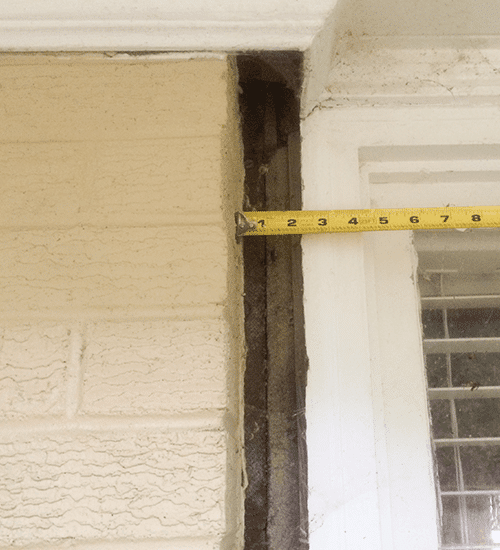
- Stair-stepped cracks in the brick or stone. Mortar joints cracking in a staircase pattern mean uneven movement along the wall.
- Diagonal cracks off door and window corners. An angled crack from a corner means the frame is being pulled out of square.
- Floors that slope or feel springy. A ball rolling on its own means support has been lost somewhere.
- Cracks that appear after heavy rain rather than during drought. More common on the limestone side, and the reverse of the usual clay pattern.
- Movement on one end of the house with the other holding square. Common near the escarpment, where a single lot can sit on two kinds of ground.
Why San Marcos Homeowners Choose Dura Pier
- 45+ Years Serving Texas
- BBB A+ Accredited
- Highly Trained Technicians
- Top Grade Materials
- Best In Class Warranties
- Financing Available
Measured, Not Eyeballed. You see the contour map before you see a price. If the readings do not justify work, we say so and you keep the data as a baseline.
The Dura Lock XD® Piling System. Ground that cycles every year works on the pilings holding your house up, and a column that merely rests in place drifts out of position over enough seasons. Dura Lock XD® is our proprietary tensioned system, built to hold the elevation we set. Learn more →
Priced by the Line. Every piling, drain run and barrier priced separately. Warranty runs for the life of the structure and transfers at no cost. See financing options →
Areas We Serve Near San Marcos
San Marcos anchors our Hays County coverage, and our crews work the surrounding communities on the same schedule.
- Kyle
- Buda
- New Braunfels
- Wimberley
- Dripping Springs
- Martindale
- Seguin
- Austin
Foundation Repair FAQs in San Marcos, TX
What kind of piers do you use here?
Dura Lock XD®, our own tensioned piling system, driven in segments. Tension is the point. On soil that expands and contracts every year, a pier that simply rests in position gets nudged loose over enough cycles. Holding the column loaded is what keeps the correction where we put it a decade later.
How deep will the piers go on my property?
Depth is set by resistance, not by a number chosen in advance. In San Marcos that varies more than almost anywhere else, because a west-side lot can hit rock within a few feet while an east-side lot needs considerably more. It can even change across a single property. Any quote that promises a fixed depth before someone has been on site is guessing.
Can drainage fix it without piers?
Sometimes, if the movement is early and driven entirely by water collecting where it should not. Correcting grade, adding drains and moving downspouts can stabilize soil moisture enough that the house settles into a steadier pattern. The elevation readings tell us whether that is realistic or whether the structure has already lost support and needs piers.
What happens to my landscaping and driveway during the work?
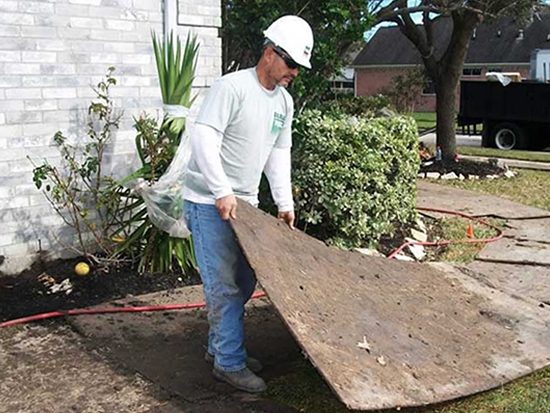
Perimeter piers require excavation at the beam, so plants and sod in a narrow band along the foundation get disturbed. We backfill and restore grade, but mature shrubs directly against the house sometimes cannot be saved. Driveways and walks are worked around where possible. We walk the property with you beforehand and tell you exactly what is affected.
Do you have to come inside my house?
Not always. Perimeter piers stay outside entirely. Interior piers are needed when the slab has dished through the middle rather than dropped at the edges, and those require cutting access holes through the floor inside. The contour map shows which situation you have, and we tell you before you commit.
What is a root barrier and how deep does it go?
A vertical barrier installed in a trench between a tree and your foundation, deep enough to intercept the feeder roots rather than just the surface mat. It redirects roots downward instead of letting them draw moisture from under your slab edge. Useful where a mature tree sits close to the house.
How do you lift a house without cracking what is attached to it?
Slowly and in a planned order. Sections come up in stages with fresh elevation readings taken at every station, so no part runs ahead of the ones beside it. Steel shims lock each section as it reaches target. On older homes with plaster or original trim, the lift gets staged in smaller increments across more passes.
Request a Free Foundation Evaluation in San Marcos, TX
You get it on paper before anyone digs: elevation readings, a contour map showing the actual shape of the movement, where water sits on your lot, a pier count with placement, and a price for each line. If the numbers do not support work, the report says so and you keep the baseline. For foundation repair in San Marcos, TX, call (512) 229-1585 or request your evaluation online.