Concrete Leveling & Lifting
Concrete does not sink on its own. The soil beneath it moves, or water carries material away, and the slab drops into the space left behind.
That means replacing the concrete without addressing what is underneath usually buys you a few years. Lifting the existing slab and filling the void underneath addresses both, costs less than replacement, and you can drive on it the same day.
Home » Residential Services » Concrete Leveling
How DuraLift™ Works
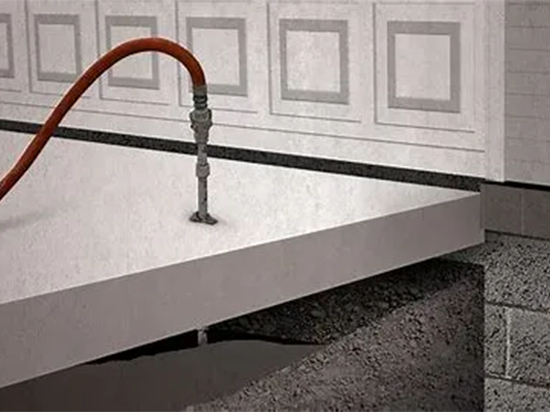
We drill a hole about 5/8 of an inch across, roughly the size of a dime, and inject a custom polyurethane blend underneath the slab. The polymer expands, fills the void, and lifts the concrete back to grade. We control the lift by watching the slab as it moves rather than by volume.
The material is environmentally safe, cures in minutes rather than days, and weighs a fraction of what mudjacking slurry weighs. That last point matters, because pumping heavy grout into soil that already could not support the slab is part of why traditional mudjacking often settles again.
When we are done there is one small patched hole instead of a demolished driveway.
What Foam Can Actually Lift
There is a lot of loose information about polyurethane lifting, so here is the honest version.
High-density structural polymers generate serious expansive force, typically 40 to 60 psi and often more. That is enough to do real work:
Monolithic slab foundations. If a home or building sits on a continuous slab that has dipped in the middle because of localized soil washout or shrinkage, foam can lift it.
Warehouse and industrial floors. Higher-density formulas are engineered specifically for thick floors carrying forklift and machinery loads.
Flatwork and roadways. Driveways, sidewalks, pool decks, parking areas, and heavy highway slabs.
Soil densification. Injected deeper into the sub-strata, foam compacts loose soil and can substantially increase the load-bearing capacity of the ground beneath a structure.
Where Foam Is Not the Answer
Foam lifts by expanding against the soil it finds. That is the whole mechanism, and it is also the limit.
It is not a permanent structural fix for a building with deep foundational movement or perimeter wall failure. When the edge of a house has settled because expansive clay is cycling at depth, pushing against that same clay does not solve anything. A pier transfers the weight of the structure down past the moving layer to competent bearing material. Foam does not do that.
So: a slab dished in the middle over a void is a foam candidate. A perimeter that has dropped through seasonal clay movement needs foundation piers.
We do both, which means we have no reason to push you toward one. Elevation readings tell us which your property needs.
Where We Use DuraLift™
- Driveways and aprons
- Sidewalks and walkways
- Patios and porches
- Pool decks
- Garage and interior slabs
- Steps and stoops
- Monolithic slab foundations with confirmed voids
- Warehouse and office floors
- Streets and parking areas


Signs Your Concrete Needs Lifting
- A lip between two slabs. Anything over a quarter inch is a trip hazard and a liability.
- Water pooling where it did not used to. A dipped section collects water and accelerates the problem.
- Doors dragging on a patio or garage slab. The slab has moved relative to the structure.
- A hollow sound when you tap it. Often indicates a void underneath.
- Cracking that follows a low spot. Concrete fails in tension. Unsupported slab bends and breaks.
- Gaps opening where concrete meets the house. Worth watching, because the water finding that gap goes straight to your foundation.
Leveling vs. Replacement
Lifting makes sense when the concrete itself is sound and the problem is what is underneath. Most sunken driveways fall into this category.
Replacement makes sense when the slab is severely cracked, spalling, crumbling at the edges, or broken into enough pieces that lifting would just rearrange them.
We will tell you honestly which you are looking at. If a driveway is past saving, lifting it wastes your money and our time. See concrete installation →

Concrete Leveling FAQs
How much does concrete leveling cost?
Considerably less than replacing the same concrete, usually by a wide margin. Cost depends on the area being lifted, how far it has dropped and how much void there is to fill. We price by line item so you can lift the sections that matter and leave the ones that do not.
How long does it take?
Most residential jobs are done in a few hours. The material cures in minutes, so you can typically walk on it immediately and drive on it the same day.
Will it sink again?
Not from the same void, which is now filled. What foam does not change is the soil conditions around it. If water is still being directed under that slab, the ground can continue to move. That is why we look at drainage as part of the assessment.
Is this the same as mudjacking?
No. Mudjacking pumps a heavy cement slurry under the slab through larger holes. Polyurethane uses much smaller holes, weighs a fraction as much, and cures in minutes instead of days. The weight difference matters, because adding heavy material to soil that already failed to support the slab is a short-term fix.
Will I be able to see the holes?
They are about the size of a dime and get patched. Visible on close inspection, not noticeable in normal use.
Is the foam safe around my landscaping and pets?
The material we use is environmentally safe and inert once cured. It is injected under the slab rather than into the surrounding soil.
Can you lift a slab that is cracked?
Often yes, if the pieces are still substantially intact. Lifting a cracked slab will not repair the crack, but it will remove the height difference and stop the trip hazard. Badly broken concrete is a replacement job.
Do you do commercial work?
Yes. See Commercial Concrete Leveling.
Book a Free Concrete Leveling Evaluation
Schedule your free, no-obligation inspection for concrete lifting and leveling.