Under-Slab Sewer Line Repair
Sewer Line Leak Under Your Home in Texas?
A leaking drain line under your slab is one of the most common causes of foundation movement in Texas, and one of the hardest to spot. The water goes into the soil beneath your house rather than onto your floor, so there is often nothing to see until the foundation starts moving.
By the time most homeowners notice, they are dealing with two problems instead of one. We handle both, because repairing a foundation without fixing the leak underneath it means doing the work twice.
How a Slab Leak Damages Your Foundation
Texas clay swells when it takes on water. A drain line leaking under your slab is doing exactly that, continuously, in one specific spot.
The soil in that area expands and stays expanded while the rest of your lot goes through its normal seasonal cycle. Your slab ends up lifted in one place and not in others, and that difference is what cracks brick and racks door frames.
It also works the other way around. Foundation movement breaks pipes. When a slab shifts, the rigid drain lines cast into or running beneath it get stressed at joints and bends. Older cast iron, already thinned by decades of corrosion, cracks first.
So the two problems feed each other. A leak moves the foundation, the movement breaks more pipe, and the new leak moves it further. Finding out which came first matters less than addressing both.
How We Find the Leak
Hydrostatic testing. The standard diagnostic. Your drain system gets plugged at the cleanout and filled with water to a set level, then monitored. If the level drops, the system is leaking. It tells you definitively whether there is a leak without tearing anything up.
Camera inspection. Once a leak is confirmed, a camera run through the line locates it and shows what you are dealing with — a cracked joint, a corroded section, a belly holding water, or roots that have found their way in.
Static and isolation testing. Narrows the leak down to a specific section so the repair can be targeted rather than replacing the whole system.
We recommend hydrostatic testing after any significant foundation lift as a matter of course. Raising a slab puts stress on the lines beneath it, and a break found immediately costs far less than one found through a wet spot months later.
Tunneling vs. Breaking Through the Slab
Once a leak is found, there are two ways to reach the pipe. This is the decision that most affects cost and disruption.
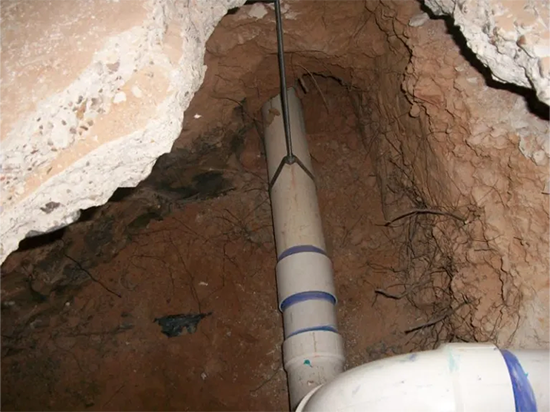
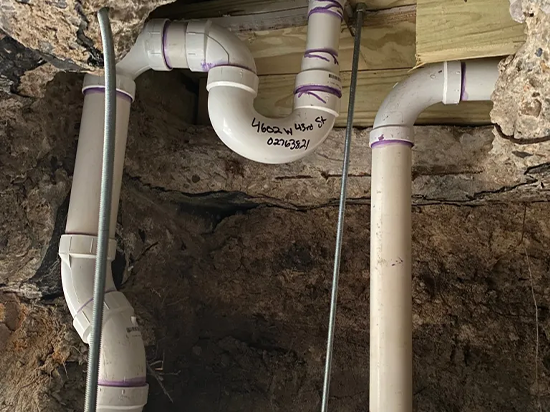
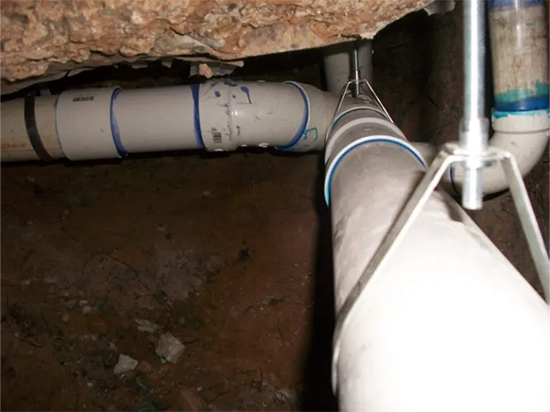
Tunneling means excavating from outside the house and working underneath the slab to reach the line. Nobody comes inside. Your flooring, cabinets and living space are untouched. Tunnels are shored as they go and backfilled and compacted afterward. It costs more per foot but avoids interior demolition entirely.
Breaking through the slab means cutting an access hole in the floor inside the house, excavating down to the pipe, repairing it, then repouring the slab and replacing the flooring. It is usually cheaper on paper, but the real cost includes removing and replacing whatever flooring was there, and the disruption of having a hole in your floor for several days.
Which makes sense depends on where the break is, what your flooring is, and how much of the line needs replacing. A break under a tiled bathroom is a different conversation from one under a hallway with carpet. We price both where both are viable so you can decide.
Signs of an Under-Slab Leak
- An unexplained jump in your water bill. The most reliable early indicator, and the one people most often dismiss.
- A warm or damp spot on the floor. More common with hot water lines, but a persistent damp patch on a slab is worth investigating either way.
- The sound of running water when nothing is on. Especially noticeable at night.
- A sewer smell inside or around the house. Escaping gas from a broken drain line often shows up before the water does.
- Cracked or loose floor tile in one area. Moisture under the slab lifts and separates tile.
- A patch of lawn that is greener or spongier than the rest. Sometimes drainage, sometimes a leaking line. Worth telling apart.
- Foundation movement concentrated in one part of the house. When cracks and sloping are confined to a single area rather than spread across the house, a localized water source is a likely cause.
Older Texas Homes and Cast Iron
Homes built before the 1970s across most of Texas have cast iron drain lines. Cast iron has a service life, and a great many of these systems are at or past it.
Corrosion thins the pipe from the inside. The bottom of the pipe goes first, because that is where waste and water sit. Eventually you get a channel rather than a pipe, then a break. Tree roots find the cracks and make it worse.
If your house is that age and has original plumbing, a camera inspection is worth doing before you have a problem rather than after. It is a small cost and it tells you whether you are looking at a spot repair or a full replacement, which is useful information when you are budgeting.
Book a Sewer Line Repair Evaluation
Schedule your free, no-obligation inspection. If you suspect a leak, we will test for it and tell you what we find, including where it is and what it will take to reach it.
Sewer Line Repair FAQs
How much does under-slab sewer line repair cost?
It depends almost entirely on access. A spot repair reached by tunneling is very different from replacing a full line, and breaking through the slab inside costs differently again once you account for flooring replacement. We price the options where more than one is viable rather than quoting a single number.
Will homeowners insurance cover it?
Sometimes, and more often than for foundation movement. Many Texas policies cover sudden and accidental water damage, and a pipe breaking under a slab can qualify. What is usually not covered is the cost of accessing the pipe, or damage from a leak that developed gradually. Read your policy and talk to your carrier before assuming either way.
Do I have to move out during the work?
Rarely. Tunneling happens entirely outside. If we are breaking through the slab, one area of your home is a work zone for several days and a bathroom may be out of service, but most people stay.
How long does a hydrostatic test take?
A couple of hours for the test itself. Camera inspection adds time. You get the result the same day rather than waiting on a report.
Should I fix the plumbing or the foundation first?
Usually the plumbing, or both together. Repairing a foundation while a leak continues underneath it means the soil keeps swelling in that spot and the repair works against an active cause. If the leak is significant, fix it first. We coordinate the sequence rather than leaving you to schedule two contractors around each other.
Will tunneling damage my yard?
There is disruption. Tunnels start from an excavation outside the house and the spoil has to go somewhere. We shore the tunnel as we go, backfill and compact properly afterward, and restore grade. Landscaping along the tunnel route is affected and we tell you which before starting.
Can roots really break a sewer line?
Yes, and it is common in older Texas neighborhoods with mature trees. Roots find their way into an existing crack or a loose joint looking for moisture, then expand and widen it. If roots are part of the problem, a root barrier is worth discussing alongside the repair.
Why does a foundation company do plumbing work?
Because the two problems are usually the same problem. Leaks move foundations and foundation movement breaks pipes, and a company that only does one will keep handing you off. Doing both means the sequencing is handled, the tunneling is done by people who understand what the slab above it needs, and nobody is blaming the other trade.
Affordable Solutions with Flexible Payment Plans
Don’t put off critical repairs. Our team will help you find the right financing plan through trusted local partners so you can get the work you need, when you need it.