Concrete Slab Foundation Repair

Cracks above your doors. A floor that slopes. Gaps opening between the wall and the trim. On a slab foundation, those are all the same problem showing up in different places: part of the house has moved and part of it has not.

Dura Pier has been repairing slab foundations in Texas for over 45 years. We drive pilings to firm bearing, lift the settled sections back toward level, and hold them there with our Dura Lock XD® system. Every repair carries a lifetime transferable warranty with no exclusions and no transfer fee.

Why Slabs Move in Texas

Most of Texas sits on expansive clay. It swells when it takes on water and shrinks when it dries, and it does that every year.

The problem is not the movement itself. It is that the movement is never even. The shaded north side of a house holds moisture longer than the sunbaked driveway edge. A mature oak pulls water out of the soil on one side. A slow plumbing leak adds it back somewhere else. Your slab sits across all of that at once, and it flexes.

Concrete handles compression well and tension poorly. When one section lifts or drops relative to another, the slab bends, and something has to give. That is what you are seeing when a crack appears above a door frame or a brick wall starts to step.

Two patterns show up most often:

Settlement. Part of the slab drops as the soil beneath it shrinks or compacts. Usually shows at a corner or along one edge, and the floor slopes toward it.

Heave. Part of the slab lifts as soil beneath it swells. Often shows in the middle of the house, sometimes after a plumbing leak has been soaking the ground under the slab for months.

They look similar from inside the house. They need different pier layouts, and telling them apart is the whole point of taking elevation readings.

How Slab Repair Actually Works

Elevation readings first. We set a benchmark, take readings across the whole floor plate, and draw a contour from those numbers. That drawing shows the shape of the movement: dropped at a corner, dished through the middle, tilted along one axis. Each needs a different approach. A quote produced without readings is a guess, and it is the most common reason a repair does not hold.

Pier placement follows the load path. Pilings go where your house actually carries its weight down into the soil, which means perimeter beams, interior grade beams and bearing points. Not evenly spaced around the outside like fence posts. If two bids differ by ten piers, one of them is wrong about your house.

Depth is set by resistance, not by a number. Each piling is driven hydraulically until it meets firm bearing. That depth varies across Texas and it varies across a single lot. Anyone promising a set depth before being on site has not accounted for that.

The lift is staged. Sections come up in stages with fresh readings taken at every station, so no part of the house runs ahead of the sections beside it. Steel shims lock the achieved elevation. Rushing this is how drywall tears and windows crack during a repair.

Tension holds it. Ground that expands and contracts every year works on the pilings, not just the house. A column that simply rests in position gets nudged out of place over enough cycles. Dura Lock XD® keeps each column loaded so it stays where we set it.

Plumbing gets checked afterward. Raising a slab puts stress on the drain lines running underneath it. A hydrostatic test after any meaningful lift is standard practice, not an upsell.
Perimeter Piers vs. Interior Piers

Worth understanding before you compare quotes, because it is the single biggest difference between a routine job and an expensive one.

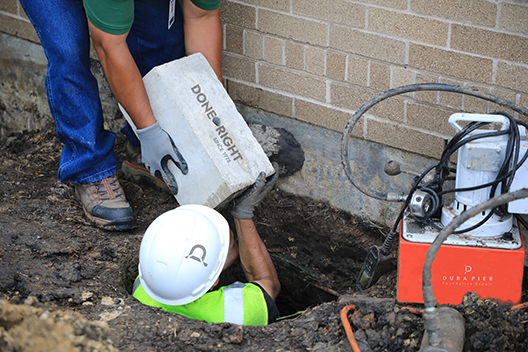
Perimeter piers go in from outside, along the edge of the slab. Crews excavate at the beam, drive the pilings, lift and shim. Nobody comes inside, your flooring is untouched, and the disruption is limited to a narrow band of yard.

Interior piers are needed when the slab has dished through the middle rather than dropped at the edges. Those require cutting access holes through the floor inside the house, which means removing flooring in those spots, working in your living space, and patching afterward. It costs more and takes longer.

The contour map tells us which you need. A contractor quoting interior piers without showing you readings that justify them is worth questioning. So is one quoting perimeter-only on a house that is clearly dished in the middle, because that repair will not hold.

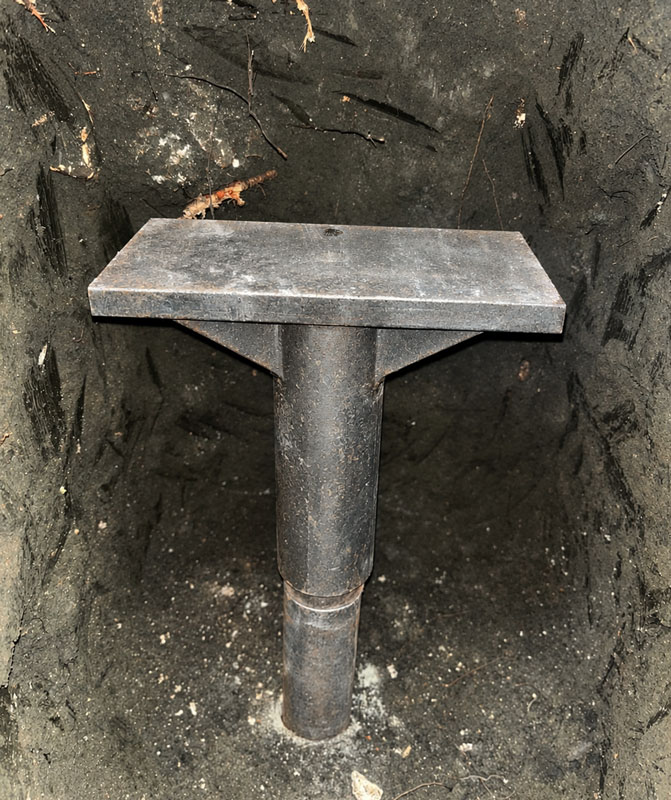
foundation steel pier - long version

Signs Your Slab Needs Attention

  • Diagonal cracks above door and window corners. The single most reliable indicator. An angled crack running off a corner means the frame is being pulled out of square.
  • Doors that stick seasonally. Binding through a wet spring and easing off in a dry summer follows soil moisture, not humidity in the wood.
  • Stair-stepped cracks in brick. Mortar joints separating in a staircase pattern mean sections of wall moving at different rates.
  • Floors that slope. Roll a ball across a few rooms. If it consistently goes one direction, that is worth measuring.
  • Gaps at trim, baseboards or countertops. Cabinets pulling away from walls, or a countertop separating from the backsplash.
  • Cracks in the slab itself. Visible in a garage or on an unfinished floor. Hairline cracks are usually shrinkage and normal. Cracks you can fit a coin into are not.
  • Soil pulled back from the slab edge. A visible gap after a dry stretch is a channel straight down to the soil you least want soaked.

Photograph anything you find with a coin next to it for scale, and note the date. A crack you can prove has widened over six months tells a very different story from one that has sat unchanged for years.

Why Choose Dura Pier for Your Foundation Repair

Worried about cracks in your foundation walls? Don’t risk your family’s safety or your home’s value.

Book a Free Slab Foundation Evaluation

Schedule your free, no-obligation inspection. Our slab foundation repair contractors will take elevation readings across your floor, show you the contour, and tell you what we find, including if the answer is that nothing needs doing yet.

Slab Foundation Repair FAQs

How much does slab foundation repair cost?

It depends on pier count, depth to firm bearing, and whether you need interior piers or only perimeter. Across Texas, moderate repairs commonly land in the low-to-mid thousands, with whole-house corrections running higher. Pier count is the biggest variable and it comes from the elevation readings rather than the size of your house. Our inspection is free and produces line-item pricing.

Anywhere from a handful to thirty or more. It is determined by the shape of the movement and where your house transfers its weight, not by square footage. Two houses of identical size on the same street can need very different numbers.

It depends on why the slab moved. High-density structural foam expands against the soil beneath the concrete and generates real lifting force, typically 40 to 60 psi or more. If your slab has dipped in the middle because a void opened under it, from soil washout or a plumbing leak that carried material away, foam is a legitimate fix and often the faster one.

Where foam does not work is perimeter settlement. Foam pushes against whatever soil it finds. A pier transfers the weight of your house down past the active soil layer to competent bearing material. When the edge of a slab has dropped because clay is cycling at depth, only the second one holds.

Elevation readings tell us which you have. We offer both, and the contour map decides.

Usually not, and any company promising that is overselling. The goal is bringing the structure back into an acceptable range and stabilising it there, not achieving a laboratory-flat floor. Over-lifting an older house does more damage than leaving a small amount of variation. We tell you what the target is before we start.

Most single-family perimeter jobs run a few days of actual work. Interior piers, tunnelling and drainage add time. The calendar window is always wider than the working days, because it includes scheduling, any permit and the plumbing test after the lift.

At least 30 days, and ideally through one wet-to-dry seasonal change. The house continues settling into its corrected position for several weeks. Patching too early usually means patching twice. Expect to adjust a few doors during that period as well.

Almost never for perimeter work, which happens entirely outside. Interior pier work is more disruptive since crews are cutting through the floor inside, and some people choose to be elsewhere for those days. We tell you which rooms are affected before starting.

Texas requires you to disclose known repairs, so plan on reporting it. What buyers and inspectors actually want is documentation and a warranty that carries over. Ours transfers to the next owner at no cost, which turns a disclosure line into evidence that the problem was handled properly rather than a reason to renegotiate.

No. Hairline cracks from concrete shrinkage are normal and appear in most slabs within the first year. What matters is width, pattern and whether it is changing. A crack you can fit a coin into, one that runs diagonally, or one that has widened over months is worth measuring.

Affordable Solutions with Flexible Payment Plans

Don’t put off repairing your slab foundation. Our team will help you find the right financing plan through trusted local partners so you can get the work you need, when you need it.

Slab Foundation Repair Across Texas

Soil conditions change significantly across our markets. Choose yours for local detail:

Scroll to Top