New Braunfels, TX Foundation Repair, Drainage Solutions & House Leveling
Home » Service Areas » New Braunfels, TX
New Braunfels Foundation Repair Services
Concrete Slab Foundation Repair
Pier and Beam Foundation Repair
New Braunfels’ older neighborhoods near downtown and Gruene still hold pier and beam homes from before 1940. We replace deteriorated wood piers and correct sagging joists.
Concrete Leveling
Sewer Line Repair
Drainage Systems
Root Barrier Installation
Comprehensive Foundation Repair Solutions for New Braunfels
Every repair plan starts with an on-site evaluation of your specific lot, not a generic city-wide assumption. New Braunfels’ split geology means two homes a mile apart can need completely different piling depths. Here is how we approach the three most common jobs we see across the city.
Slab Elevation and Piling Systems
On the deep clay east of downtown, we drive pilings to refusal, often past the 6 to 10 feet of vertisol above stable substrate in this part of Comal and Guadalupe counties. Our Dura Lock XD® tensioned piling system locks each pier under load, so the slab stays supported through the next wet-to-dry cycle. We lift the slab with hydraulic rams in a controlled sequence, monitoring elevation readings so no single point takes on more stress than it should. Steel shims lock in final elevation at each pier. Homes in newer I-35 corridor subdivisions, built on poured slabs over this deeper clay, need this approach most often.
Crawl Space and Pier & Beam Work
New Braunfels has a real concentration of pier and beam homes, especially in the Central Historic District and around Landa Park, where construction dates back to the 1840s through the 1930s. Many crawl spaces still have original wood piers, rotted or shifted after decades of moisture cycling off the Comal and Guadalupe Rivers. We replace failed piers, install steel shims to correct joist-level unevenness, and lay vapor barriers to cut the humidity that speeds up wood rot here. Floor deflection readings guide exactly where new support goes.
Drainage Solutions for River-Adjacent Soil
New Braunfels has flooded before, including major events in 1998 and 2002 along the Guadalupe, and the ground here holds moisture differently than drier parts of Central Texas. Homes near River Chase, Gruene, and other river-corridor neighborhoods sit on soil that swings from saturated to bone-dry faster than clay farther from the water. We install French drains and surface grading that route water at least five feet from the foundation, cutting the swings that drive clay expansion. On the shallower west-side limestone, drainage work focuses on keeping water from pooling over the thin clay cap, which has almost no buffer before it reaches rock.

Common Foundation Problems in New Braunfels, TX
Understanding local geology is the first step in foundation repair in New Braunfels, TX. The city sits on the Balcones Fault Zone, which puts Edwards Limestone under the western half of the city and expansive Blackland Prairie clay under the eastern half and river corridor. On the west side, only 12 to 24 inches of clay typically separates a foundation from fractured limestone below, so that thin layer absorbs and releases moisture fast, creating sharp, compressed swings in soil volume. On the east side, clay runs much deeper, so more total soil volume expands and contracts with every rain-to-drought cycle, adding up to more foundation movement over time.
Both soil types respond the same way to New Braunfels’ climate: heavy rain off the Guadalupe and Comal watersheds saturates the clay, then weeks of dry heat pull the moisture back out. That repeated cycle is what cracks slabs, shifts piers, and pulls foundations out of level across the city.
Early Signs of Foundation Movement in New Braunfels Homes
- Sheetrock cracks near door frames and ceiling corners, often the first visible sign of slab movement.
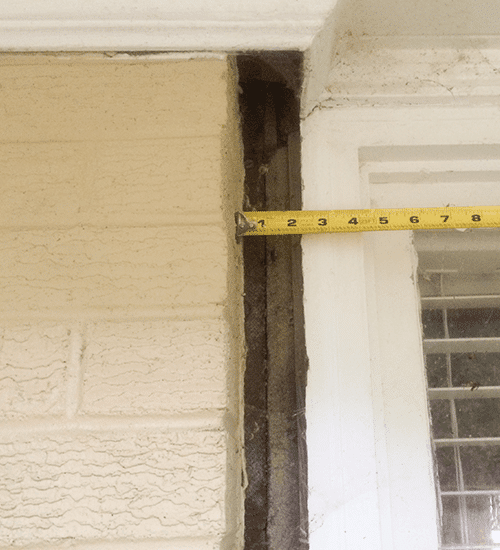
- Brick veneer stair-stepping, diagonal cracks that climb through mortar joints on the exterior.
- Doors and windows that bind or no longer latch, especially after a wet season.
- Floor deflection, noticeable sloping or bounce underfoot in pier and beam homes.
- Soil separation at the beam, a visible gap opening between the foundation and the ground around it during dry months.
- Interior slab cracks that widen after flood events, a pattern we see more in New Braunfels than in drier parts of Texas, tied to the rapid saturation-to-drought cycles along the Comal and Guadalupe corridors.
Why New Braunfels Homeowners Choose Dura Pier
- 45+ Years Serving Texas
- BBB A+ Accredited
- Highly Trained Technicians
- Top Grade Materials
- Best In Class Warranties
- Financing Available
Our Diagnostic Process
Before we recommend a repair plan, we take detailed elevation readings across your slab or floor system and map the contour of the movement. This tells us whether we’re dealing with a localized issue, like settlement near one corner over shallow limestone, or a broader pattern common on deeper east-side clay. That data drives where piers go and how many are needed.
The Dura Lock XD® Piling System
Our proprietary Dura Lock XD® is a tensioned piling system built to hold a foundation steady through the expansion and contraction cycles New Braunfels soil produces year after year. Each pier is tensioned under the slab rather than simply set beneath it, keeping the system locked in place as the ground around it keeps moving.
Transparent Pricing and Our Lifetime Warranty
Every estimate is line-item, so you know what you’re paying for before work starts. We back repairs with a lifetime transferable warranty, no exclusions and no transfer fees if you sell the home. We also offer 0% interest financing.
Areas We Serve Near New Braunfels
- San Marcos
- Schertz
- Austin
- Canyon Lake
- Garden Ridge
- McQueeney
- Gruene
- San Antonio
Foundation Repair FAQs in New Braunfels, TX
How much does foundation repair cost in New Braunfels?
How long does foundation repair take?
Is foundation movement in New Braunfels really caused by the soil?
Will my homeowners insurance cover foundation repair?
Can small cracks in my slab wait, or should I get them checked now?
Do older pier and beam homes near downtown need different repairs than newer slab homes?