Taylor, TX Foundation Repair & House Leveling
Over two days in September 1921, Taylor recorded 23.11 inches of rain in a single 24-hour stretch. Barely any of it soaked in. Blackland clay bakes shut in a Central Texas summer, so the water ran off into Brushy Creek and the San Gabriel instead of down. That runoff-then-swell cycle is still what moves slabs here, which is why foundation repair in Taylor, TX starts with soil behavior rather than crack patching. Dura Pier measures the movement before pricing anything.
Home » Service Areas » Taylor, TX
Taylor Foundation Repair Services
Two very different housing generations live in this town, sometimes on the same block. We match the work to which one you own.
Concrete Slab Foundation Repair
New construction is not immune to Blackland clay. A slab poured on ground that has not finished settling can show movement inside its first few years. See slab foundation repair →
Pier and Beam Foundation Repair
Pre-war framing needs different handling than a slab. Access underneath, careful staged lifting, and attention to what a century of ground moisture has done to the wood. See pier & beam repair →
Concrete Leveling
Flatwork settles on its own schedule. Lifting and re-supporting the existing panel beats demolition and a new pour. See concrete lifting →
Sewer Line Repair
Drainage Systems
Flat grading on very slowly permeable clay means runoff sits. Getting it away from the perimeter is structural work, not yard work. See drainage solutions →
Root Barrier Installation
Older Taylor lots have big canopies. Those root systems pull moisture out of clay that is already cycling on its own every year. See deep root barrier →
Foundation Repair in Taylor, TX: The Three Problems We Solve
Every job here comes down to three questions. How deep does the soil keep moving, what is actually holding the house up, and where does water go once it leaves your roof. The answers differ sharply between a house from the original plat and one poured last year, so the plans differ too.
Reaching Past the Zone That Keeps Moving
Depth is the whole argument in Blackland clay. Houston Black opens cracks up to four inches wide at a foot down during a dry stretch, and slickensides show that the profile has been shearing against itself from roughly two feet down to eight. A piling that stops inside that band gets carried along with it. Ours are advanced hydraulically until they meet firm resistance, which in Taylor means pushing through weathered Taylor Marl toward denser material below. The Taylor Group is not uniform, either. Geologists divide it into the Sprinkle Formation at the base, the Pecan Gap Chalk above that, and the Bergstrom Formation on top, so what a piling meets at fifteen feet on one lot is not what it meets on the next. Spacing along the perimeter beam is set by the load above and the resistance below, not by a standard interval.
Getting a Pre-War House Level and Keeping It There
Houses near the original 36-block plat were built when Taylor was a railroad and cotton shipping town, and a good number of them sit on raised wood framing. Access underneath is the advantage. What we find down there is usually some combination of rotted sill plate, sagging girders and interior pads that have punched down into the clay. Work runs in a sequence: map the floor contour first, then jack in small increments rather than one long lift, so plaster and original millwork above have time to move with the frame instead of tearing. Shims go in as each section reaches its target. A vapor barrier across the ground cuts the moisture load that started the rot in the first place.
Keeping Runoff From Standing Against the Slab
Nothing about Taylor’s soil handles a heavy rain gracefully. Houston Black takes on water fast when it is cracked open and almost refuses it once it is wet, so the second inch of a storm behaves completely differently from the first. Water that cannot infiltrate goes looking for the low point, and on a lot with flat grading that low point is often the slab edge. Grade correction comes first. After that we run French drains with enough fall at the invert to keep moving, size catch basins to the area they actually serve, and carry downspouts well past the foundation line. Root barrier trenches, where mature pecans or live oaks are pulling moisture from under the perimeter, have to reach the feeder roots rather than the surface mat.

Common Foundation Problems in Taylor, TX
The formation under this town is named after this town. Robert T. Hill described the Taylor marls in 1889 from exposures near Taylor and formalized the name in 1892, and the USGS still records the unit as named from Taylor Prairie. It runs as thick as 500 feet in central Texas and weathers into a highly plastic, montmorillonite-rich clay. Above it sits Houston Black, the Texas state soil, spread across more than a million and a half acres of Blackland Prairie. Both belong to the same family of soils that expand hard when wet and contract hard when dry.
Two things make that worse locally. The first is the runoff behavior the 1921 storm demonstrated so brutally: baked clay sheds water rather than absorbing it, so the soil around your house can go from bone dry to fully saturated in hours, then back again over weeks. The second is Taylor’s construction timeline. This town had 7,875 residents in 1940 and 16,267 in 2020, which means the housing stock skips most of the postwar slab boom that fills other Texas cities. What we see instead is a lot of pre-war framing and a rapidly growing volume of very new slabs, with a thin band in between. Those two groups fail differently and need different repairs.
Early Signs of Foundation Movement in Taylor Homes
- At the front door: a door that seals in March and drags by late August is following soil moisture, not swelling in the humidity.
- In the hallway: long diagonal cracks off the top corners of door frames mean the frame is racking rather than the drywall drying.
- In the bathroom: cracked grout lines, popped tile at the threshold, or a toilet that rocks slightly all point to deflection in the slab beneath.
- In the garage: a crack running the width of the slab, or a gap opening where the garage floor meets the house, often shows up before anything appears inside.
- Along the exterior brick: mortar joints separating in a staircase pattern mean sections of the wall are moving at different rates.
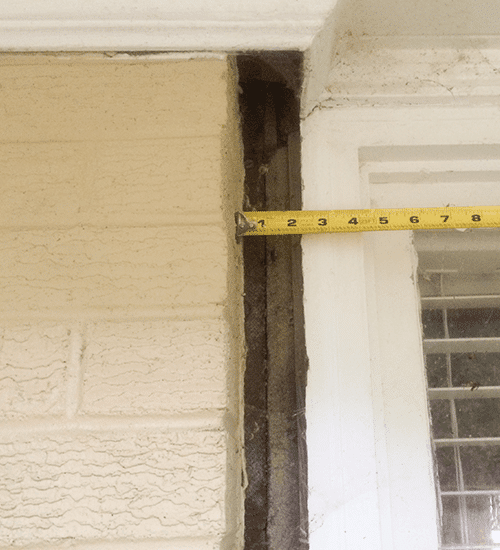
- Around the slab edge outside: during a Taylor dry spell the clay can crack four inches wide and pull visibly away from the beam, and that gap is a channel straight down to the soil you least want soaked.
Why Taylor Homeowners Choose Dura Pier
- 45+ Years Serving Texas
- BBB A+ Accredited
- Highly Trained Technicians
- Top Grade Materials
- Best In Class Warranties
- Financing Available
Readings Decide the Pier Count
Elevation numbers, not opinions, determine how many pilings go under your Taylor house and where. We set a benchmark, shoot readings across the whole floor and build a contour from them. A slab that dropped at one corner needs a very different layout from one that dished through the middle, and the difference between those two is often several pilings and several thousand dollars. You see the contour before you see a price.
The Dura Lock XD® Piling System
Ten years is the real test. Any competent crew can get a house level on the day of the lift. What matters on Blackland clay is whether the correction survives a decade of that soil swelling and shrinking underneath it, and that is what Dura Lock XD®, our proprietary tensioned piling system, is built to do. Learn more about Dura Lock XD® →
Line-Item Pricing and a Warranty That Moves With the House
Each piling, each drain run and each barrier is priced separately on your estimate. The warranty runs for the life of the structure, has no exclusions, and transfers to the next owner without a fee. See financing options →
Areas We Serve Near Taylor
- Hutto
- Georgetown
- Round Rock
- Granger
- Thrall
- Coupland
- Elgin
- Pflugerville
Request a Free Foundation Evaluation in Taylor, TX
Here is what the free evaluation actually includes. A benchmark and a full set of floor elevations. A contour map showing the shape of the movement rather than a list of the cracks. An assessment of where water is going on your lot. A pier count with placement, or a clear statement that the numbers do not justify work yet. Then line-item pricing, 0% financing options and a transferable lifetime warranty if you decide to proceed. For foundation repair in Taylor, TX, call (512) 229-1585 or book online.