Round Rock, TX Foundation Repair & Drainage Solutions
Home » Service Areas » Round Rock, TX
Round Rock Foundation Repair Services
Concrete Slab Foundation Repair
Pier and Beam Foundation Repair
Concrete Leveling
Sewer Line Repair
Drainage Systems
Root Barrier Installation
Comprehensive Foundation Repair Solutions for Round Rock
Round Rock’s split geology changes the engineering. A home in Paloma Lake and a home in Chisholm Valley can show the same crack and need completely different work underneath. The three sections below explain what our crews actually do on Round Rock properties, and why depth, sequencing, and drainage matter more here than in flatter, more uniform Texas markets.
Slab Elevation and the Dura Lock XD® Piling System
Work begins with a zip-level survey. We shoot elevations across your slab on a grid and build a floor contour map showing the high point and how far each corner has dropped. On Round Rock slabs, the low readings usually appear at the exterior corner facing the longest afternoon sun exposure. Pilings are driven in segments under the perimeter grade beam and pressed until refusal, the point where the column reaches strata that will not compress further. East of I-35, through the moisture-active clay zone, that can mean 12 to 20 feet or more. Closer to the escarpment on the west side, refusal often comes shallower on limestone. The Dura Lock XD® system then tensions the piling column so the segments lock as one unit instead of depending on friction. Hydraulic rams lift in sequence, a fraction of an inch at a time, while we watch interior cracks close. Steel shims set the final elevation.
Crawl Space and Pier & Beam Work
Round Rock’s pre-war housing sits in the blocks around the 1876 to 1881 commercial core. Those homes were built on cedar posts, cut stone, or later concrete block. Three problems repeat here. Sills and floor joists rot where crawl space humidity has never been controlled. Interior piers settle unevenly because they were never founded below the active clay zone. And decades of additions created seams that move independently from the original structure. We take elevation readings on the finished floor rather than the slab, then shim or replace piers to bring the framing back into plane. Rotted members get sistered or replaced outright. A sealed vapor barrier and corrected ventilation keep the wood dry afterward. Where a pier has no real footing, we install a new tensioned support driven to refusal.
Drainage, the Round Rock Variable Nobody Prices In
Round Rock has an entire government body devoted to its water. The Upper Brushy Creek WCID was created in 1956 and maintains a network of earthen dams built between 1957 and 1967, now protecting more than 40,000 homes. After Tropical Storm Hermine flooded the city in 2010, the district launched the Lake Creek study that produced Dam 101. Over 80 homes and every road in the Lake Creek area of west Round Rock sit in the 100-year floodplain. That context matters for your slab. Water that ponds against one side of a house swells that clay while the shaded or covered side stays dry, and the differential is what cracks sheetrock. We correct surface grade to move water away from the beam, extend downspouts past the drip line, and install subsurface drainage systems where lot slope alone cannot do it. On homes where a leak is the actual moisture source, we also handle sewer line repair.

Common Foundation Problems in Round Rock, TX
The soil under most of the city is a Vertisol. Clay content in the Houston Black series runs between 46 and 60 percent, and permeability is very slow. When it dries, the surface cracks open more than four inches wide and a foot deep, and those cracks stay open 90 to 150 days in a typical year. When rain finally arrives, the clay absorbs water and expands with enough force to lift concrete. Williamson County holds some of the most extensive acreage of this soil in the state. Your foundation is riding on a material that changes volume every season.
West Round Rock behaves differently. Near the Balcones Escarpment the section includes Del Rio Clay over Edwards and Buda limestone. The trouble there is the interface. Water perches on the rock beneath the clay and cannot drain, which produces slickensides and creates movement in a home whose neighbor two streets away sits on solid limestone and never moves at all. This is why a Round Rock diagnosis has to be property specific.
Early Signs of Foundation Movement in Round Rock Homes
- Sheetrock cracks at door and window corners. Diagonal cracks running from the upper corner of a frame are the earliest interior signal.
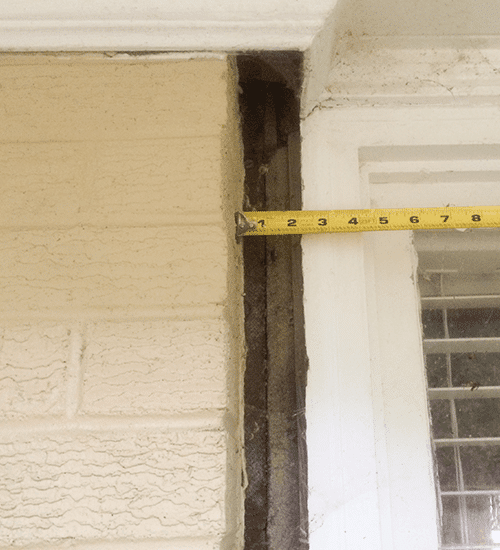
- Stair-stepping in brick veneer. Look along the mortar joints on the exterior, especially at corners and above garage openings.
- Doors and windows that bind. A door that latched fine in June and sticks in September is tracking your soil moisture.
- Floor deflection you can feel. Slopes, soft spots, or a marble that rolls consistently one direction.
- Soil pulling away from the grade beam. In late summer you can see a visible gap between the dirt and the concrete.
- Gilgai mounding in the yard. Low mounds and shallow depressions across a Blackland lot are the surface signature of soil that is actively churning underneath.
Why Round Rock Homeowners Choose Dura Pier
- 45+ Years Serving Texas
- BBB A+ Accredited
- Highly Trained Technicians
- Top Grade Materials
- Best In Class Warranties
- Financing Available
We Measure Before We Quote
Every evaluation starts with elevation readings across the floor and a contour map of the results. That map tells us whether you are looking at real structural settlement, seasonal movement that will reverse, or a drainage problem wearing a foundation costume. You get to see the numbers. Plenty of Round Rock homes we survey do not need piers at all, and we will tell you so.
The Dura Lock XD® Tensioned Piling System
Standard segmented pilings rely on friction and alignment to stay stacked. Dura Lock XD® tensions the column so segments act as a single member, which matters in soil that heaves upward as hard as it settles downward. Depth is determined by refusal at your property, not by a default number applied citywide.
Transparent Pricing and a Warranty That Transfers
You get an itemized proposal showing pier count, locations, and scope before anything starts. The work carries a lifetime transferable warranty on a single page, with no exclusions and no transfer fee, so it moves to the next owner when you sell. 0% interest financing is available for qualified homeowners. We also handle commercial foundation repair for property managers and business owners.
Areas We Serve Near Round Rock
Foundation Repair FAQs in Round Rock, TX
How much does foundation repair cost in Round Rock?
Do I need a structural engineer before hiring a contractor?
How long does the work take?
Most residential slab jobs in Round Rock finish in two to five working days from the first excavation to backfill and cleanup. Pier and beam projects vary more because access under the structure drives the schedule. Drainage corrections are often one or two days. We give you a date range in writing with the proposal.
Why did my foundation crack after a dry summer instead of after rain?
My neighborhood is west of the escarpment. Is that better or worse?
Is the warranty still good if I sell the house?