Grand Prairie, TX Foundation Repair & Slab Leveling

Grand Prairie stretches nearly 40 miles from the Trinity River in the north to Joe Pool Lake in the south, crossing three counties on the way. The ground changes as you go. Most of the city sits on Eagle Ford Shale, which weathers into the dark, waxy clay North Texans call black gumbo, and the southern end climbs toward the Austin Chalk escarpment where rock sits closer to the surface. Foundation repair in Grand Prairie, TX depends on knowing which of those you are on. Dura Pier uses floor elevation readings to find out what your house is actually doing before recommending anything.

Grand Prairie Foundation Repair Services

A city this long does not have one soil condition or one type of housing. We match the work to the property.

Concrete Slab Foundation Repair

Concrete Slab Foundation Repair

Most Grand Prairie homes sit on slab-on-grade. Pilings go past the layer that keeps moving and the low sections come back toward level. See slab foundation repair →

Pier and Beam Foundation Repair

Pier and Beam Foundation Repair

Older properties in the central and northern parts of the city predate slab construction. Access underneath is the advantage; decades of ground moisture is the problem. See pier & beam repair →

Concrete Leveling

Driveways, walks and patios settle on their own schedule. Lifting and re-supporting the existing panel costs less than tearing it out. See concrete lifting →

Pier and Beam Foundation Repair

House Raising

Properties in the Trinity River and Mountain Creek corridors carry flood exposure. Raising the structure changes both the risk and the insurance picture. See house raising →

Drainage system installation

Drainage Systems

Eagle Ford clay takes water fast when it is cracked open and almost refuses it once wet. Water that cannot soak in collects at your slab edge. See drainage solutions →

Root Barrier Installation Service

Root Barrier Installation

Mature trees in the older neighborhoods pull moisture from clay that is already cycling hard on its own. A barrier redirects those roots down and away from your perimeter. See root barrier installation →

What Foundation Repair Actually Involves

Most people getting bids have never had this work done and have no way to judge what they are being told. Here is what the process should look like.

It starts with measurement, not a crack tour. A benchmark gets set and floor elevations are read across the whole slab, then drawn as a contour. That drawing shows whether the house dropped at a corner, dished through the middle, or tilted along one axis. Those three need different pier layouts and different pier counts. A quote produced without readings is a guess.

Pier count comes from the readings and the structure. Pilings go where the house actually carries its weight down — perimeter beams, interior grade beams, bearing points — not evenly spaced around the outside like fence posts. If two bids differ by ten piers, one of them is wrong about your house.

Depth is set by resistance. Each piling gets driven until it meets firm bearing rather than to a preset number. That depth varies across Grand Prairie and can vary across a single lot, which is why a fixed-depth quote is a warning sign.

The lift is staged. Sections come up in stages with fresh readings at every station, so no part runs ahead of the ones beside it. Steel shims lock the achieved elevation. On older homes with cast iron drain lines, a hydrostatic test afterward is standard rather than optional.

Drainage usually needs addressing too. Piers stabilize the house. They do not change where water goes on your lot, and water is what moved the soil in the first place.

Questions worth asking any contractor bidding your job: how many piers and why that number, what depth and how is it determined, is the price broken out by line, does the warranty transfer, and will you show me the elevation readings.


Early Signs of Foundation Movement in Grand Prairie Homes

Doors that bind by season. Sticking through a wet spring and easing off in a dry August tracks soil moisture, not humidity in the wood.

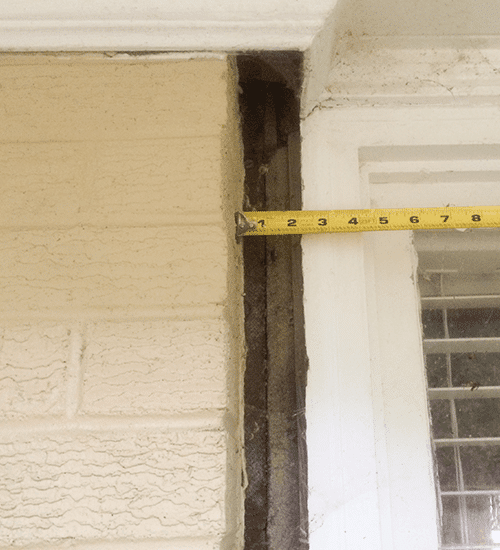
Stair-stepped cracks in the brick. Mortar joints separating in a staircase pattern mean sections of wall are moving at different rates.

Diagonal cracks off door and window corners. An angled crack from a corner means the frame is being pulled out of square.

Floors that slope or feel springy. A ball that rolls on its own, or flex underfoot in a raised-foundation home, means support has been lost.

Soil pulled back from the slab edge. A visible gap after a dry stretch is a channel straight down to the soil you least want soaked.

Movement on one end of the house while the other stays square. Common here, because Eagle Ford clay can swell and contract by as much as seven inches as moisture changes, and it rarely does so evenly across a lot.

Why Grand Prairie Homeowners Choose Dura Pier

  • 45+ Years Serving Texas
  • BBB A+ Accredited
  • Highly Trained Technicians
  • Top Grade Materials
  • Best In Class Warranties
  • Financing Available

Measured, Not Eyeballed

You see the contour map before you see a price. If the readings do not justify work, we say so and you keep the data as a baseline to re-measure against next year.

The Dura Lock XD® Piling System

Ground that expands and contracts every year does not just move a house. It works on the pilings holding it up, and a column that merely rests in place gets pushed out of position over enough cycles. Dura Lock XD® is our proprietary tensioned piling system, built to hold the elevation we set. Learn more about Dura Lock XD® →

Priced by the Line

Each piling, drain run and barrier is priced separately on your estimate, so nothing hides in a lump sum. The warranty runs for the life of the structure and transfers to the next owner at no cost. See financing options →

Areas We Serve Near Grand Prairie

Grand Prairie spans Dallas, Tarrant and Ellis counties, and our crews work the surrounding communities on the same schedule.

Foundation Repair FAQs in Grand Prairie, TX

What does foundation repair cost in Grand Prairie?

Across North Texas, moderate repairs commonly land in the low-to-mid thousands, and whole-house corrections with drainage run higher. Pier count is the biggest variable and it comes from elevation readings, not the size of the house. Anyone quoting a price over the phone is guessing. Our on-site evaluation is free.

It can. Most of Grand Prairie sits on Eagle Ford clay that swells and shrinks with the seasons. Toward the southern end near Joe Pool Lake the ground rises toward the Austin Chalk, where rock is closer to the surface and piers are often shorter. Same symptoms inside the house, different work underneath.

Most single-family pier jobs take a few days of actual work. Older raised-foundation homes take longer because the lifting is staged. Tunneling and drainage add time. The calendar window is wider than the working days because it includes scheduling, permits and the plumbing test.

Not on every job. In Texas, only a licensed professional engineer can issue an engineering evaluation of a structure. A contractor cannot. That report is worth getting when movement is severe, when a lender or insurer asks for one, or when you want an opinion from someone with no stake in the repair.

Not without checking what is behind it. Low bids often mean fewer piers than the house needs, a shallower system, or a warranty with enough exclusions that it will not help you. Compare pier count, depth, line-item pricing and warranty terms before comparing totals.

We recommend a hydrostatic test after any real lift. Raising a slab stresses the drain lines beneath it, and finding a break right away costs far less than finding it through a wet spot next spring. See sewer line repair →

Request a Free Foundation Evaluation in Grand Prairie, TX

You get it all on paper before anyone digs: elevation readings, a contour map showing the actual shape of the movement, where water is sitting on your lot, a pier count with placement, and a price for each line rather than one number. If the readings do not support doing work, the report says exactly that and you keep the baseline. For foundation repair in Grand Prairie, TX, call (214) 699-4784 or request your evaluation online.

Scroll to Top