Clear Lake, TX Foundation Repair, Concrete Leveling & Drainage
Clear Lake sits about 20 feet above sea level, a short distance from Galveston Bay, on coastal prairie clay that drains very slowly. Most of the housing here went up after 1963, when the community was master-planned around what became the Johnson Space Center, so a large share of homes share a build era and a foundation type. Foundation repair in Clear Lake comes down to two things: soil that swells and shrinks every year, and a water table that sits close to the surface. Dura Pier uses floor elevation readings to find out what your house is actually doing.
Home » Service Areas » Clear Lake, TX
Clear Lake Foundation Repair Services
Clear Lake’s housing is largely a single generation, built from the mid-1960s onward on slab foundations. That makes the failure patterns here fairly consistent.
Concrete Slab Foundation Repair
Nearly all Clear Lake homes are slab-on-grade. Pilings go past the moving layer to firm bearing. See slab foundation repair →
Pier and Beam Foundation Repair
A smaller number of older properties around the edges sit on raised framing, and damp crawl spaces are the recurring issue this close to the bay. See pier & beam repair →
Concrete Leveling
Driveways, walks and patios settle separately from the house. See concrete lifting →
House Raising
Properties in the bay and creek corridors carry real storm surge and flood exposure. See house raising →
Drainage Solutions
Flat ground, slow-draining clay and a high water table mean water sits where it lands. See drainage solutions →
Root Barrier Installation
Trees planted when these neighborhoods went in are mature now and drawing moisture from under your perimeter. See root barrier installation →
Living at Twenty Feet: What That Means for Your Foundation
Elevation matters more here than in most of the Houston area, for two reasons.
The water table sits close to the surface. Coastal prairie soils in this area stay saturated within a couple of feet of the surface through winter and early spring. That constant moisture keeps soil conditions in flux around your foundation, and it is why crawl spaces in this area rarely dry out.
The land itself has dropped. Over the last century, groundwater pumping across the Houston-Galveston Bay area caused more than ten feet of subsidence in places, enough to shift the coastline and change where wetlands sit. The Harris-Galveston Subsidence District was created in 1975 specifically to end subsidence that contributes to flooding and inundation.
That regional settling is not what cracks an individual slab. What it does is change where water goes across whole neighborhoods, and combined with 20 feet of elevation and clay that will not absorb, it means your lot has fewer places to send water than it once did.
The practical takeaway is that drainage here is structural work, not landscaping. Correcting grade at the slab edge and getting water clear of the perimeter does more to protect a Clear Lake foundation than almost anything else you can do.
Early Signs of Foundation Movement in Clear Lake Homes
- Doors that bind by season. Sticking in a wet spring and easing in a dry late summer tracks soil moisture.
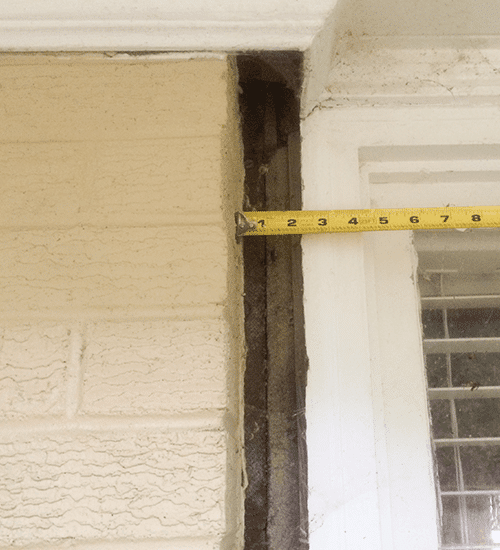
- Stair-stepped cracks in the brick. Mortar joints cracking in a staircase pattern mean uneven movement along the wall.
- Diagonal cracks off door and window corners. An angled crack from a corner means the frame is racking.
- Floors that slope or feel springy. A ball rolling on its own means support has been lost.
- Soil pulled back from the slab edge. A visible gap after a dry stretch channels water straight down.
- New movement showing up months after a storm. Long saturation followed by a hard dry-out is the cycle that moves clay, and the result often appears well after the water is gone.
When the Answer Is That You Don't Need Us
Not every house with cracks needs piers. Slabs shift within construction tolerance, drywall cracks as houses dry out, and doors stick for reasons that have nothing to do with the foundation.
When the elevation readings say your house is fine, that is what our report says. You get the numbers, an explanation of what they show, and a recommendation to re-measure in a year. No work quoted, no follow-up calls.
That is worth knowing before you book anyone, because a free inspection from a company that only makes money selling piers has a built-in pull toward finding something.
Everything in Writing Before Anyone Digs
The pier count and placement, the drainage scope, a price for each line rather than one number, and the warranty terms. The warranty runs for the life of the structure, has no exclusions, and transfers to the next owner at no charge.
45+ years in Texas, family-owned across three generations, BBB A+ accredited.

Areas We Serve Near Clear Lake
Clear Lake anchors our Bay Area coverage in southeast Harris County, and our crews work the surrounding communities on the same schedule.
- League City
- Friendswood
- Pasadena
- Deer Park
- Seabrook
- Webster
- El Lago
- Houston
Foundation Repair FAQs in Clear Lake, TX
What does foundation repair cost in Clear Lake?
Most Houston-area jobs land between $3,500 and $10,000, with typical projects around $5,000 to $6,000. Small repairs cost less; whole-house leveling and interior piers can exceed $15,000. Pier count is the biggest variable and it comes from elevation readings, not square footage.
What piers are commonly used in Clear Lake, and what do you install?
Pressed concrete cylinder piles and steel pressed piles are the two systems most often quoted in this market, driven hydraulically to refusal. On a high water table you want a system that reaches genuinely competent bearing rather than stopping in saturated soil. We install Dura Lock XD®, our own tensioned segmented system, which stays loaded so the column holds its position.
Can polyurethane foam injection level my house instead of piers?
Depends on the cause, and the water table here makes the answer lean one way more often.
Structural foam does real work. It lifts monolithic slabs over voids, fills washouts, and densifies loose soil. Those are genuine applications and we use it.
The complication in Clear Lake is that foam needs something to push against, and saturated coastal soil gives it less resistance than firm ground would. When a slab here has settled because the clay beneath it is cycling and the water table is sitting a couple of feet down, a pier driven to competent bearing is the more reliable answer.
Where we would recommend foam is a slab dipped over a genuine void, and for driveways, patios and pool decks.
How long should I wait to patch drywall cracks after leveling?
At least 30 days, and ideally through one wet-to-dry seasonal change. The house settles into its corrected position over several weeks and small movements during that window are normal. Patching too early usually means doing it twice. Expect to adjust doors during that period as well.
Does the high water table change the repair?
It changes the depth conversation. Piers need to reach material that is genuinely competent rather than stopping in soil that stays saturated most of the year. It also raises the importance of drainage, because a lot that cannot shed water keeps the soil around your foundation in a constant state of change.
Do you check the plumbing afterward?
We recommend a hydrostatic test after any real lift. Raising a slab stresses the drain lines beneath it, and many Clear Lake homes are old enough to have cast iron. See sewer line repair →
Request a Free Foundation Evaluation in Clear Lake, TX
You get it on paper before anyone digs: elevation readings, a contour map, where water sits on your lot, a pier count with placement, and a price for each line. If the numbers do not support work, the report says so and you keep the baseline. For foundation repair in Clear Lake, call (713) 721-8888 or request your evaluation online.