McKinney, TX Foundation Repair, Concrete Leveling & Drainage
There is no part of McKinney that escapes expansive clay. Collin County sits almost entirely within the Blackland Prairie, and unlike Tarrant or Bexar County there is no sandy zone to move into. Deep clay over marl and chalk, county-wide. The clay here also happens to be among the most reactive in Texas, with plasticity index values above 44. That is why foundation repair in McKinney, TX so often comes down to getting pilings below the layer that keeps moving. Dura Pier uses floor elevation readings to find out what your house is actually doing before recommending anything.
Home » Service Areas » McKinney, TX
McKinney Foundation Repair Services
McKinney spans a historic downtown that predates the Civil War and master-planned neighborhoods still under construction. Same clay underneath, very different houses on top.
Concrete Slab Foundation Repair
Most McKinney homes sit on slab-on-grade, and the newer ones on engineered fill brought in to level the lot. Pilings go past the moving layer to firm bearing. See slab foundation repair →
Pier & Beam Repair
The oldest homes near downtown were built on raised wood framing long before slabs were standard. Access underneath is the advantage; a century of ground moisture is the problem. See pier & beam repair →
Concrete Leveling
Driveways, walks and patios settle on their own schedule. Lifting and re-supporting the existing panel costs less than tearing it out. See concrete lifting →
House Raising
Properties in mapped flood areas along the creek corridors carry repeat exposure. Raising the structure changes both the risk and the insurance picture. See house raising →
Drainage Systems
Blackland clay takes water fast when it is cracked open in August and almost refuses it once wet. Water that cannot soak in collects at your slab edge. See drainage solutions →
Root Barrier Installation
Mature trees in the older neighborhoods pull moisture from clay that is already cycling hard on its own. A barrier redirects those roots down and away from your perimeter beam. See deep root barrier →
Common Foundation Problems in McKinney
The ground under McKinney is deep clay sitting on Cretaceous marl and chalk. The Austin Chalk alone surfaces across nearly half of Collin County, with the Ozan Formation making up much of the rest. The soils that weathered off those formations are the ones that cause trouble.
Plasticity index is the number that matters, because it measures how much a soil expands and contracts as moisture changes. The clays derived from the Ozan Formation here run high. Houston Black comes in around 44, Heiden around 42, Ferris around 47, and Trinity clay above 51. For comparison, anything over 35 is considered highly expansive. There is no low-plasticity soil in this county to build on instead.
What that means for your house is simple. The clay swells in a wet spring and shrinks in a dry August, and it does not do it evenly. The shaded north side, the sunbaked driveway edge, a thirsty oak and a slow plumbing leak all pull the soil in different directions at once. A slab caught over that lifts on one side and holds on the other. That difference is what cracks brick and jams doors, and it is why elevation readings tell you far more than a walk around looking at cracks.
If Your Home Is New Construction
Worth knowing separately. McKinney has grown fast, and a large share of homes here are less than twenty years old, built on fill brought in to level a sloped lot.
Fill behaves differently from native clay. Clay swells and shrinks, cycling back and forth with the seasons. Fill consolidates in one direction under the weight of the house and does not come back. Some settling in the first year or two is normal. Movement that keeps progressing is not.
If your builder warranty is still active, get elevation readings taken now. Documented numbers are the strongest thing you can bring to that conversation, and they cost you nothing.

Early Signs of Foundation Movement in McKinney Homes
Doors that bind by season. Sticking through a wet spring and easing off in a dry August tracks soil moisture, not humidity in the wood.
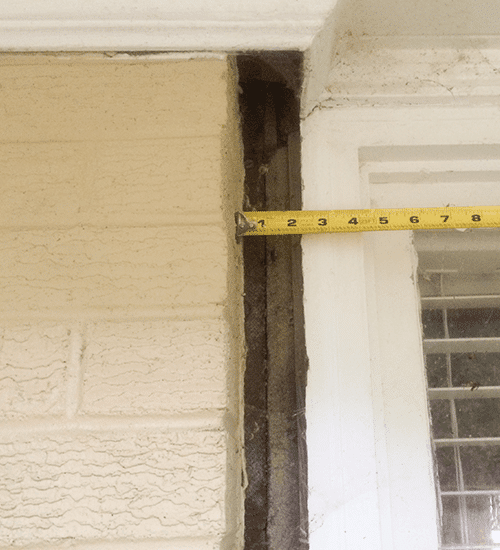
Stair-stepped cracks in the brick. Mortar joints separating in a staircase pattern mean sections of wall are moving at different rates.
Diagonal cracks off door and window corners. An angled crack from a corner means the frame is being pulled out of square.
Floors that slope or feel springy. A ball that rolls on its own, or flex underfoot in a raised-foundation home, means support has been lost.
Soil pulled back from the slab edge. A visible gap after a dry stretch is a channel straight down to the soil you least want soaked.
Steady movement in one direction with no seasonal rebound. On newer construction this pattern points to fill settling rather than clay cycling, and it calls for a different pier depth.
Why McKinney Homeowners Choose Dura Pier
- 45+ Years Serving Texas
- BBB A+ Accredited
- Highly Trained Technicians
- Top Grade Materials
- Best In Class Warranties
- Financing Available
Measured, Not Eyeballed
Cracks tell you something happened. They do not tell you the shape of it, and the shape decides the repair. We set a benchmark, shoot elevation readings across the whole floor, and build a contour from those numbers. You see it before you see a price. If the readings do not justify work, we say so and you keep the data.
The Dura Lock XD® Piling System
Clay with a plasticity index above 44 does not just move a house. It works on the pilings holding it up, and a column that merely rests in place gets pushed out of position over enough wet and dry cycles. Dura Lock XD® is our proprietary tensioned piling system, built to hold the elevation we set. Learn more about Dura Lock XD® →
Priced by the Line
Each piling, drain run and barrier is priced separately on your estimate, so nothing hides in a lump sum. The warranty runs for the life of the structure and transfers to the next owner at no cost. See financing options →
Areas We Serve Near McKinney
McKinney anchors our Collin County coverage, and our crews work the surrounding communities on the same schedule.
Foundation Repair FAQs in McKinney, TX
What does foundation repair cost in McKinney?
Across North Texas, moderate repairs commonly land in the low-to-mid thousands, and whole-house corrections with drainage run higher. Pier count is the biggest variable, and it comes from elevation readings rather than the size of the house. Anyone quoting a price over the phone is guessing. Our on-site evaluation is free.
My house is only a few years old. Should it be moving?
Some settling in the first year or two is normal as fill finds equilibrium. What is not normal is movement that keeps progressing, cracks that widen month over month, or a floor reading out of level beyond construction tolerance. Get elevations taken while any builder warranty is still active.
How long does the work take?
Most single-family pier jobs take a few days of actual work. Older raised-foundation homes take longer because the lifting is staged. Tunneling and drainage add time. The calendar window is wider than the working days because it includes scheduling, permits and the plumbing test after the lift.
Do I need a structural engineer?
Not on every job. In Texas, only a licensed professional engineer can issue an engineering evaluation of a structure. A contractor cannot. That report is worth getting when movement is severe, when a lender or insurer asks for one, or when you want an opinion from someone with no stake in the repair.
Is the clay here worse than the rest of DFW?
It is among the most reactive, and there is less variety. Some counties in the metroplex have sandy zones where the ground behaves differently. Collin County does not. The soil survey maps six associations across the county and every one is clayey or loamy prairie. That makes the diagnosis more predictable, which is genuinely useful.
Do you test the plumbing afterward?
We recommend a hydrostatic test after any real lift. Raising a slab stresses the drain lines beneath it, and finding a break right away costs far less than finding it through a wet spot next spring. See sewer line repair →
Request a Free Foundation Evaluation in McKinney, TX
You get it all on paper before anyone digs: elevation readings, a contour map showing the actual shape of the movement, where water is sitting on your lot, a pier count with placement, and a price for each line rather than one number. If the readings do not support doing work, the report says exactly that and you keep the baseline. For foundation repair in McKinney, TX, call (214) 699-4784 or request your evaluation online.