College Station, TX Foundation Repair & Slab Leveling
A door that sticks all spring and swings free by August. A crack above a window that opens after a hard rain, then holds still for months. Those two patterns account for most of the calls we take here, and both trace to the same thing. The ground under this city is not the deep black clay people assume it is. It is a sandy surface layer sitting on a dense clay subsoil, and those two layers behave nothing alike. Dura Pier reads the whole profile before recommending anything.
Home » Service Areas » College Station, TX
Foundation Repair Services in College Station
Concrete Slab Foundation Repair
Southwood Valley, South Knoll, Bee Creek and the neighborhoods that followed are slab-on-grade. Pilings go past the active layer to firm bearing, then the low side comes back toward level. See slab foundation repair →
Pier and Beam Foundation Repair
The oldest housing stock in the city sits on raised wood framing. Working room underneath is the advantage. Persistent damp in the crawl space is the recurring problem. See pier & beam repair →
Concrete Leveling
Flatwork settles independently of the house next to it. Lifting and re-supporting the existing panel costs less than tearing it out. See concrete lifting →
Sewer Line Repair
Drainage Systems
Water perching on a claypan does not drain on its own schedule. Getting it out from under the slab edge takes subsurface work, not just regrading. See drainage solutions →
Root Barrier Installation
Post Oak Savannah is exactly what it sounds like. Those trees draw moisture from the same clay layer your foundation is bearing on. See deep root barrier →
Common Foundation Problems in College Station, TX
Two soil series dominate the ground here, and both were formally described from type locations right in Brazos County. Boonville is a fine sandy loam over very slowly permeable clay. Zack sits on dense deltaic sediments of the Yegua Formation and has an abrupt texture change at about seven inches, with the cracking and shrink-swell behavior concentrated in the layer from roughly seven to twenty-four inches down. Soil scientists call that structure a claypan. It is common through the Post Oak Savannah and it is nothing like the uniform black clay of the prairie counties to the north.
That distinction matters more than it sounds. On a deep clay, rain soaks in slowly and the whole profile swells together. On a claypan, rain moves through the sandy top layer quickly, reaches the dense clay, and then stops going down and starts going sideways. Water perches at that contact and travels laterally until it finds somewhere to go, which is often under the edge of a slab. So the soil under one corner of a house can be saturated while the soil eight feet away is still dry, and that difference is what tilts a foundation. Grading the yard alone does not fix it, because the problem is happening below the surface, not on it.
Early Signs of Foundation Movement in College Station Homes
Listed roughly from least to most urgent.
- Hairline cracks in the slab or driveway. Usually cosmetic. Photograph them with a coin for scale and note the date so you have a reference point.
- Doors and windows that bind by season. Sticking through a wet spring and easing off in a dry late summer follows soil moisture, not humidity in the woodwork.
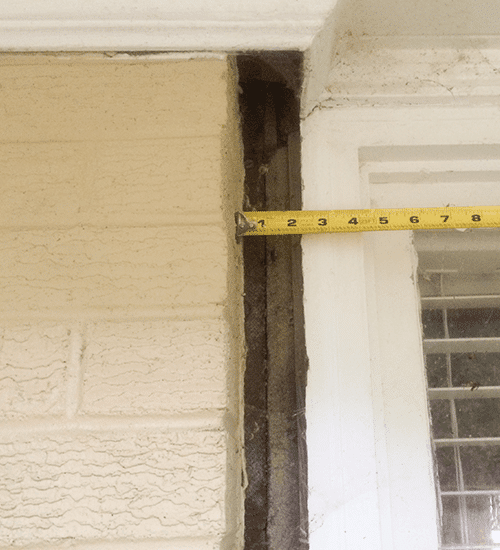
- Diagonal cracks off door and window corners. An angled crack running from a corner means the framing is being racked out of square.
- Separation at trim, baseboards or brick. Mortar joints cracking in a staircase pattern, or baseboards pulling off the floor, show sections moving at different rates.
- Floors that slope or give underfoot. A ball rolling on its own, or flex in a raised-foundation floor, means support has already been lost somewhere.
- Movement concentrated on one side of the house with the other side square. On a claypan this is the signature pattern, because perched water saturates one part of the lot while the rest stays dry.
How We Approach Foundation Repair in College Station
Three questions decide the scope of any job here. How deep the movement actually goes, what is carrying the structure now, and where water is sitting after a storm. Claypan soil changes the answer to all three compared with the deep clay most Texas repair methods were built around, so here is how our crews work through each one.
How Deep Do Pilings Go in Brazos County Soil?
Deeper than the layer that is moving, which on a claypan is a more specific target than it sounds. The shrink-swell behavior in these profiles concentrates in a band starting a few inches down and running to roughly two feet, with denser and more stable material below that. A piling that stops inside the active band moves with it. Ours are advanced hydraulically until each meets firm resistance rather than to a preset depth, and on Yegua-derived ground that resistance depth varies noticeably across a single lot because the underlying sediments are interbedded sands and clays rather than one uniform mass. Spacing follows the load path — perimeter beams, interior grade beams, bearing points — not an even ring around the outside of the house.
What Does Crawl Space Work Look Like in the Older Neighborhoods?
Slower and more careful than slab work. Houses in the Southside area date to the 1920s through the 1940s, some of them relocated from the Texas A&M campus, and the framing is a century old in places. We map the floor contour first to find where support has actually been lost, then work through the combination of failed pier pads, sagging girders and rot at the sill that decades of ground moisture produce. Lifting happens in small increments over several passes rather than one long jack, so original plaster, trim and single-pane glass have time to travel with the frame. Shims lock each section as it reaches target. A ground vapor barrier cuts the moisture load that caused the rot to start with.
Why Does Drainage Work Differently on a Claypan?
Because the water you need to move is already underground. On uniform clay, surface grading and gutter extensions solve most of it, since water that cannot infiltrate simply runs off. Here the top layer accepts water readily and then hands it to a dense subsoil that will not take it, so it perches and travels sideways at that contact. Surface work alone misses it entirely. What works is intercepting the perched water before it reaches the foundation: subsurface interceptor drains set at the depth of the contact rather than a few inches down, French drains with real fall at the invert, and in some cases a vertical moisture barrier along the perimeter to stop lateral migration under the slab edge. Surface grading and downspout extensions still matter. They are just not sufficient by themselves. See drainage solutions →

Why College Station Homeowners Choose Dura Pier
- 45+ Years Serving Texas
- BBB A+ Accredited
- Highly Trained Technicians
- Top Grade Materials
- Best In Class Warranties
- Financing Available
The Contour Map Comes Before the Quote
Cracks tell you something happened. They do not tell you the shape of it. We set a benchmark, take elevation readings across the entire floor plate, and build a contour from the numbers, and that drawing is what determines the repair. A slab that dropped at one corner and a slab that dished through the middle can look identical from inside the house and need completely different pier layouts. You see the contour before you see a price.
The Dura Lock XD® Piling System
Ground that swells and shrinks every year does not just push a house around. It works on the pilings holding that house up, and a column that is merely resting in place gets nudged out of position over enough seasons. Dura Lock XD® is our proprietary tensioned piling system, designed to stay loaded so it holds the elevation we set rather than drifting with the soil. Learn more about Dura Lock XD® →
Written Terms, Line by Line
Each piling, drain run and barrier is priced separately, so nothing hides inside a lump sum. The warranty runs for the life of the structure, fits on a single page with no exclusions, and transfers to the next owner at no cost. See financing options →
Areas We Serve Near College Station
Request a Free Foundation Evaluation in College Station, TX
Get a measurement before you get a quote. Our free evaluation starts with a benchmark and elevation readings across your entire floor, produces a contour map showing the actual shape of the movement, and includes an assessment of where water is sitting on your lot. If the numbers do not justify work yet, we say so and tell you what to watch. When they do, you get line-item pricing, 0% financing options and a warranty that transfers with the property. For foundation repair in College Station, TX, call (713) 721-8888 or book online.