
You’re standing in your bathroom when you notice water pooling near the baseboards. The floor feels damp, and there’s a musty smell you can’t quite place. After calling a plumber, you hear words that make your stomach drop: “You have a broken pipe under slab.” Suddenly, you’re facing a decision that affects your home’s foundation, your daily routine, and your budget. The question isn’t just about fixing a leak—it’s about choosing the right method to access pipes buried beneath tons of concrete.
When it comes to under slab sewer line repair, homeowners face three primary approaches: tunneling under the foundation from outside, rerouting pipes through accessible areas like attics or walls, or cutting through the concrete slab from inside your home. Each method serves specific situations, and understanding when to use each approach makes the difference between a smart repair and an expensive mistake. This guide walks you through the technical details, real-world applications, and decision factors that help you choose the right solution for your home.
Understanding Under Slab Plumbing Repair: The Challenge Beneath Your Foundation
Under slab plumbing repair presents a unique challenge that sets it apart from typical plumbing work. Unlike pipes running through walls or ceilings that you can access by opening drywall, pipes beneath your concrete foundation sit trapped under thousands of pounds of concrete, rebar, and whatever flooring you’ve installed above. This inaccessibility drives both the complexity and cost of repairs.
The fundamental problem is straightforward: you need to reach a damaged pipe that’s buried where you can’t see it or easily access it. A cracked pipe under slab doesn’t announce itself with obvious signs until water damage becomes severe. By the time you notice damp floors, unexplained water bills, or foundation cracks, the leak may have been active for weeks or months.
Houston under slab plumbing faces additional challenges from the region’s expansive clay soils. These soils expand when wet and contract when dry, creating constant pressure on pipes buried beneath your foundation. This movement stresses pipe joints and can cause failures even in relatively new plumbing systems.
The repair method you choose determines not just how the pipe gets fixed, but how much disruption you’ll experience, what restoration work you’ll need afterward, and whether you’re addressing just the immediate problem or preventing future failures. Let’s examine each method in detail.
What Causes a Broken Pipe Under Slab and Why It Matters
Before diving into repair methods, understanding why pipes fail helps you make better decisions about long-term solutions. A broken pipe under concrete slab typically results from one of several causes: corrosion eating through older metal pipes, soil movement stressing pipe joints, poor initial installation creating weak points, or simply age-related deterioration of pipe materials.
When you discover a single isolated leak, it might represent a one-time failure that targeted repair can address. However, if inspection reveals multiple weak spots or widespread corrosion, that single visible leak is just the first symptom of systemic pipe failure. This distinction between isolated damage and widespread deterioration fundamentally changes which repair method makes sense.
A sewer line leak under slab also poses health risks beyond property damage. Sewage contains bacteria and pathogens that contaminate soil beneath your foundation. Left unaddressed, this contamination can affect indoor air quality and create hazardous conditions. The urgency of repair increases when sewage rather than clean water is involved.
Tunneling Under Foundation: The Exterior Access Method
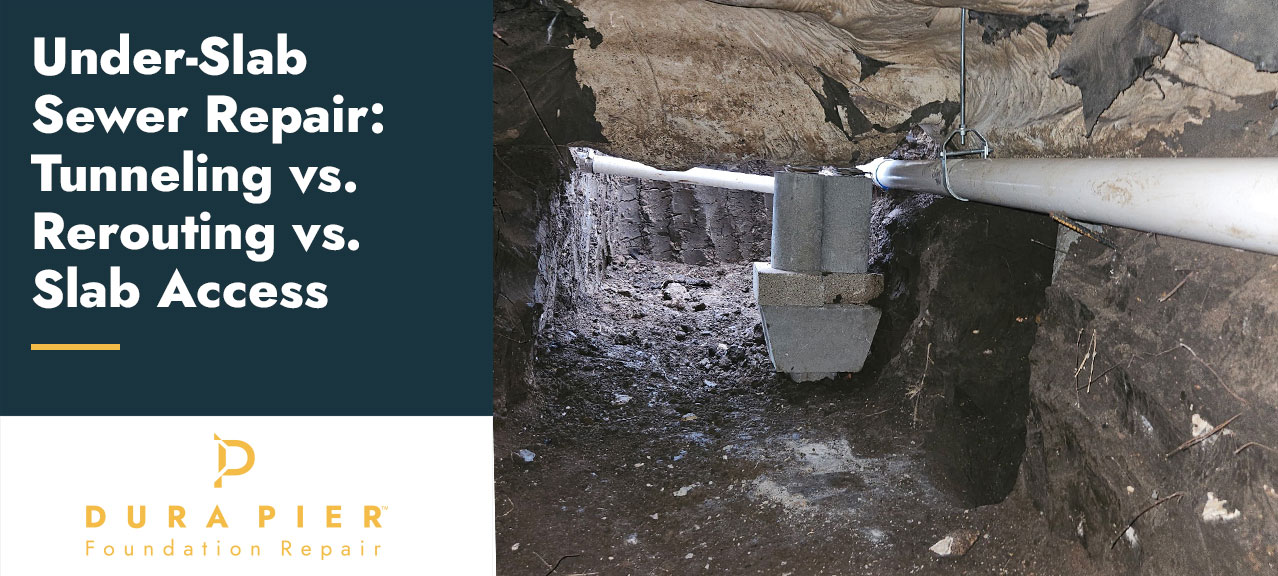
Tunneling represents the least invasive approach to your home’s interior. Instead of cutting through floors and disrupting your living space, this method creates underground passages from outside your home to reach the damaged pipe section.
The process starts with excavating an access pit outside your home, typically near the foundation perimeter. From this starting point, workers dig a horizontal tunnel beneath the slab, carefully navigating toward the location of the damaged pipe. The tunnel must be large enough for a person to work in while maintaining structural integrity to prevent foundation settling.
Once the tunnel reaches the damaged section, plumbers can repair or replace the affected pipe segment within this underground workspace. After completing the repair, the tunnel gets backfilled with a specialized slurry designed to prevent future settling and maintain the foundation’s structural support.
When Tunneling Makes Sense
Foundation tunnel repair shines in specific scenarios. If you’ve recently renovated your home with expensive hardwood floors, custom tile work, or other premium finishes, tunneling preserves these investments completely. You won’t need to cut through your beautiful floors, match discontinued tile patterns, or repaint walls affected by concrete dust.
The method works particularly well for single pinhole leaks located within 10 to 15 feet of your home’s perimeter. The closer the leak sits to the foundation edge, the less excavation is required, which directly affects both timeline and expense. Conversely, a leak located deep under the center of your home requires extensive tunneling that may make other methods more practical.
Homes with post-tension foundations—concrete slabs containing structural cables under tension—benefit significantly from tunneling. Cutting through a post-tension slab without knowing the exact location of these cables risks damaging them, potentially compromising your entire foundation’s structural integrity. Tunneling completely avoids this risk by accessing pipes from below rather than cutting through the slab.
The Tunneling Experience
From a homeowner’s perspective, tunneling offers remarkable convenience. Your daily routine continues largely uninterrupted. You don’t need to move furniture, cover belongings to protect them from dust, or relocate temporarily. The work happens outside and underground, away from your living spaces.
The timeline typically spans 2 to 5 days, depending on the distance from the perimeter to the leak location, soil conditions, and the depth of the pipe. While this represents a longer timeline than some alternatives, the lack of interior disruption often makes the extended duration acceptable.
After completion, you’ll need to address landscaping around the excavation site. If the access pit crossed a driveway, patio, or other hardscape, restoration of these areas adds to the project scope. However, these exterior restoration tasks pale in comparison to the interior work required by other methods.
Limitations to Consider
Concrete slab plumbing repair through tunneling does have drawbacks. The method proves impractical when multiple leaks exist along the same pipe line. If your inspection reveals several failures, this indicates the entire pipe is deteriorating. Repeatedly tunneling to address each new leak as it appears costs more than replacing the entire line through rerouting.
The timeline of 2 to 5 days exceeds faster alternatives, which matters if you’re dealing with an active sewage leak creating urgent health concerns. The careful excavation process and proper backfilling requirements simply take time to complete correctly.
Replacing Sewer Pipe Under Slab Through Rerouting
Rerouting takes a fundamentally different approach. Instead of accessing and repairing the damaged under-slab pipe, this method abandons the problematic line entirely and installs a completely new pipe route through accessible areas of your home.
The process begins by capping off the damaged under-slab line at both ends, effectively abandoning it in place. Plumbers then install a new pipe route that bypasses the slab completely, typically running through your attic or within walls to connect fixtures to the main sewer line. This new route uses modern piping materials and can be designed to avoid future accessibility issues.
The Strategic Advantage of Complete Replacement
Sewer line replacement under slab through rerouting addresses a critical reality: when one section of pipe fails, the entire line is often compromised. If your camera inspection reveals widespread corrosion, multiple weak spots, or deteriorating pipe material throughout the line, attempting to repair individual sections is like patching holes in a sinking boat. The entire line needs replacement, which rerouting accomplishes efficiently.
This method proves particularly valuable when dealing with older homes where original plumbing has reached the end of its service life. Rather than facing repeated repairs as different sections fail over the coming years, rerouting provides a permanent solution with modern materials backed by long-term warranties.
Speed and Practicality
Most rerouting projects are completed in 1 to 2 days. This rapid timeline minimizes disruption to your household and allows you to return to normal routines quickly. The speed advantage becomes particularly important when dealing with sewage leaks that create urgent health and safety concerns.
The method also excels when leak locations make other approaches impractical. A leak located deep under the center of your home, beneath structural elements, or in otherwise inaccessible areas can be bypassed entirely through rerouting. You’re not constrained by the physical challenge of reaching the damaged section—you simply avoid it.
What to Expect During Rerouting
While rerouting avoids cutting your concrete slab, it does require opening drywall to run new pipes through walls or accessing your attic for overhead routing. This means you’ll need drywall repair, texture matching, and repainting in affected areas. The extent of this work depends on your home’s layout and the complexity of the new pipe route.
Homes with accessible attic spaces and straightforward wall structures experience less invasive rerouting. Conversely, homes with limited attic access, complex architectural features, or specific structural constraints may face more extensive interior work.
The new pipe route becomes easily accessible for any future maintenance needs. Unlike under-slab lines that require major work to access, rerouted pipes in attics or walls can be reached through simple access panels. This accessibility provides long-term value and peace of mind.
When Rerouting Is the Clear Choice
Replacing plumbing in concrete slab through rerouting becomes the obvious choice when inspection reveals systemic pipe failure. If the pipe material itself is compromised throughout its length due to corrosion, age, or material defects, no amount of targeted repair will prevent continued failures. The entire line needs replacement.
Multiple leaks in the same line also point toward rerouting. Each additional leak multiplies the disruption and expense of other repair methods, while rerouting addresses all current and future problems in that line with a single project.
Slab Cutting: Direct Access to a Broken Pipe Under Concrete Slab
Slab cutting, also called breaking the slab, represents the most direct approach. This traditional method involves cutting through your concrete foundation from inside the home to access the damaged pipe directly.
The process starts with precisely locating the damaged pipe section using detection equipment. Once located, workers use concrete saws or jackhammers to cut through the slab, creating an opening large enough to access the pipe. After completing the repair or replacement, the concrete must be repoured and allowed to cure before the area can be restored with flooring.
The Direct Approach Advantage
For a single, easily accessible leak, slab cutting can provide the quickest route to repair. The straightforward nature of cutting directly to the problem eliminates the complexity of underground excavation or routing new pipes through your home’s structure. When the situation is simple—one isolated leak in an accessible location with no signs of widespread pipe deterioration—direct access makes practical sense.
The method also works well for leaks located deep under the center of your home. When a leak sits far from the foundation perimeter, tunneling would require extensive excavation. In these cases, cutting directly through the slab from above provides more practical access.
The Reality of Interior Disruption
Slab cutting creates substantial disruption to your living space. The process generates significant noise from jackhammers and concrete saws that makes remaining in the home difficult. Concrete dust spreads throughout nearby rooms despite containment efforts, settling on furniture, in air vents, and on belongings.
You’ll need to move furniture and belongings away from the work area, and many homeowners find the disruption severe enough to require temporary relocation during the work. The process affects not just the immediate work area but adjacent rooms and spaces.
Flooring Challenges and Hidden Costs
Cutting through the slab necessitates removing flooring in the affected area. This creates both immediate and long-term challenges. Matching existing flooring materials—especially hardwood, tile, or discontinued products—proves difficult and expensive. Even when matching materials can be found, achieving seamless integration with existing flooring remains challenging.
Many homeowners discover that replacing just the damaged section looks noticeably different from the surrounding floor, leading to the decision to replace flooring in the entire room. This unexpected expense can significantly increase the total project cost beyond the initial repair estimate.
The concrete itself must cure properly before flooring can be replaced, extending the timeline and leaving your home in a disrupted state for several days. During this curing period, you’ll have an exposed concrete patch in your floor.
Critical Safety Considerations
For homes with post-tension foundations, slab cutting carries significant risks. These foundations contain structural cables under tension within the concrete. Cutting through the slab without knowing the exact location of these cables can damage them, potentially compromising your foundation’s structural integrity. This risk requires careful assessment before proceeding with slab cutting.
The method also proves inefficient when multiple leaks exist. Each additional leak requires another section of slab to be cut, multiplying the disruption, expense, and flooring damage. When facing multiple failures, the cumulative impact of slab cutting often exceeds the total disruption and expense of rerouting the entire line.
When Sewer Line Replacement Under Slab Becomes Necessary
Understanding when to repair versus replace your under-slab sewer line represents a critical decision point. Several factors indicate that complete replacement through rerouting makes more sense than targeted repairs through tunneling or slab cutting.
Camera inspection of your entire line provides the data you need. If the inspection reveals widespread corrosion, multiple weak spots, or deteriorating pipe material throughout the line, the single visible leak is just the first symptom of systemic failure. The entire line is compromised and will continue failing at different points.
Recurring leaks over time also signal the need for complete replacement. If you’ve already repaired one section and now face another failure, this pattern indicates the pipe has reached the end of its service life. Continuing to repair individual sections costs more in the long run than replacing the entire line once.
The age and material of your pipes matter significantly. Older cast iron pipes commonly used in homes built before the 1970s are particularly prone to corrosion and failure. If your home has original plumbing from this era, complete replacement with modern materials provides long-term value and eliminates the cycle of repeated repairs.
Modern Alternatives for Replacing Plumbing in Concrete Slab
Beyond the three traditional methods, modern trenchless technologies offer additional options for certain pipe conditions. These methods deserve consideration as they can provide significant advantages in appropriate situations.
Cured-in-place pipe (CIPP) lining represents a revolutionary approach that inserts a new pipe within your existing damaged pipe. The process involves thoroughly cleaning the existing pipe, inserting a resin-saturated liner through access points, inflating the liner to conform to the pipe interior, and curing the resin using heat or UV light to create a new pipe within the old one.
This method can be completed in approximately 2 hours and typically costs 30% to 50% less than full dig-and-replace methods when considering total expenses including restoration. The dramatic time savings and reduced disruption make trenchless lining attractive when pipe conditions permit its use.
However, CIPP lining only works when the existing pipe is mostly intact with minor cracks or leaks. It cannot address severely damaged or collapsed pipes. The pipe diameter and material must also be suitable for lining, and adequate access points must exist for liner insertion. When these conditions are met, trenchless lining offers the fastest, least invasive solution available.
Houston Under Slab Plumbing: Regional Considerations
Houston under slab plumbing faces unique challenges that influence repair method selection. The region’s expansive clay soils are known for significant movement with moisture changes. These soils expand when wet and contract when dry, creating constant pressure on pipes buried beneath foundations. This soil behavior contributes to pipe failures and may influence the frequency of repairs needed.
The area’s high humidity and periodic flooding can affect both the repair process and long-term pipe performance. Proper drainage around excavation sites becomes particularly important to prevent water accumulation that could compromise repairs or cause future settling.
Local plumbing codes and permit requirements may also influence method selection or require specific installation standards. Working with experienced local professionals who understand these regional factors ensures your repair meets all requirements and addresses Houston-specific challenges.
Making Your Decision: A Practical Framework
Selecting the optimal repair method requires evaluating multiple factors specific to your situation. Start by getting a professional camera inspection of your entire line to assess overall pipe condition. This inspection reveals whether you’re dealing with an isolated failure or systemic deterioration.
Consider the number and pattern of leaks. A single isolated leak suggests targeted repair through tunneling or slab cutting might work. Multiple leaks in the same line indicate systemic failure that requires complete replacement through rerouting.
Evaluate the leak location. Leaks within 10 to 15 feet of your foundation perimeter make tunneling viable. Leaks deep under your home’s center favor slab cutting or rerouting. Consider accessibility for each method based on your home’s specific layout.
Assess your interior finish quality. Expensive hardwood, tile, or custom flooring strongly favors tunneling to preserve these investments. Recent renovations make interior preservation particularly valuable. Basic carpet or vinyl flooring makes slab cutting’s disruption more acceptable.
Verify your foundation type. Post-tension slabs make tunneling the safest choice and create significant risks for slab cutting. Standard reinforced slabs allow all methods to be considered.
Review overall pipe condition from your camera inspection. Isolated damage in an otherwise sound pipe supports repair-focused methods. Widespread corrosion or deterioration requires complete replacement through rerouting. Mostly intact pipes with minor damage may qualify for trenchless lining.
Taking the Next Step
A broken pipe under slab demands prompt attention, but rushing into a repair method without proper assessment leads to poor decisions. The right approach starts with professional diagnosis that includes camera inspection of your entire line, precise leak detection, foundation type verification, and accessibility assessment for all viable methods.
This professional evaluation provides the data you need to make an informed decision rather than relying on general guidelines or a contractor’s preferred method. Different situations call for different solutions, and understanding your specific circumstances ensures you choose the method that provides the best long-term value for your home.
Dura Pier Foundation Repair understand plumbing problems are stressful, and dealing with under slab sewer line repair adds complexity to an already challenging situation. Our goal is to help you understand your options clearly so you can make the right decision for your home and family. Whether tunneling preserves your beautiful interior finishes, rerouting provides a permanent solution to systemic pipe failure, or modern trenchless methods offer the fastest repair, the right choice depends on your unique situation.
Let’s get started with this quick form. We’ll take care of it with the expertise and honesty you deserve, providing clear explanations and reliable solutions that give you peace of mind for years to come.