
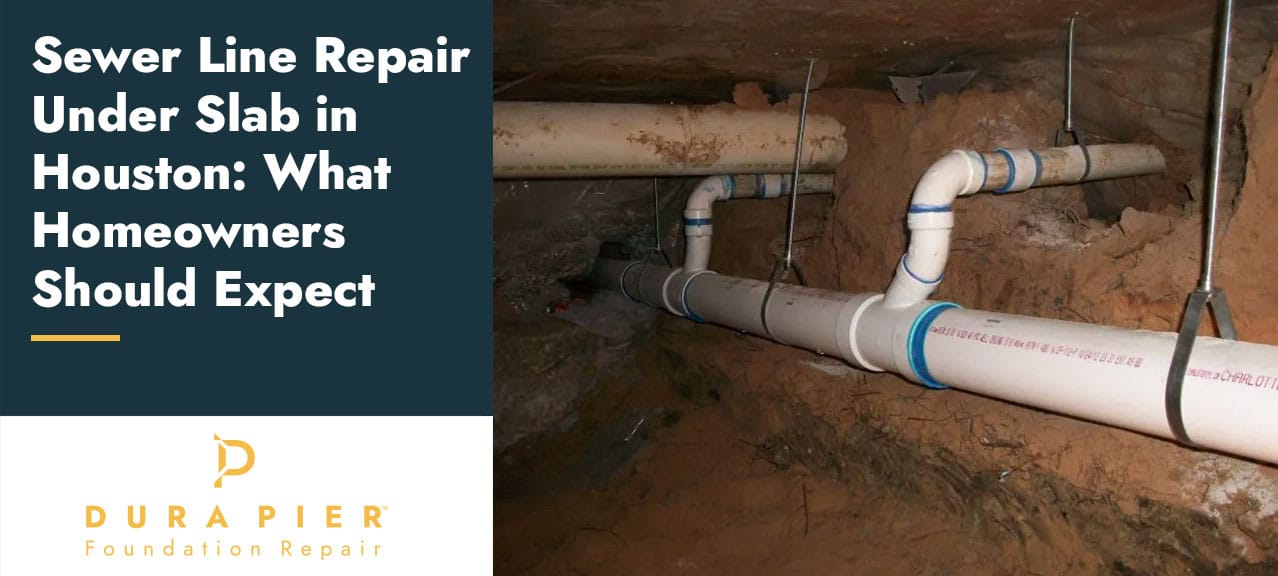
When homeowners need sewer line repair under slab in Houston, the biggest concern is often access. Sewer and drain lines can run directly beneath a home’s concrete foundation, making a damaged pipe more complicated to diagnose and repair than an ordinary plumbing problem.
Dura Pier has served Greater Houston homeowners for more than 45 years. During that time, we have seen how clay-rich soils, periods of drought followed by heavy rainfall, aging plumbing systems, drainage conditions, and foundation movement can contribute to problems beneath slab foundations.
If you suspect a sewer line problem beneath your home, this guide explains what to expect, including how contractors reach the damaged pipe, common repair methods, potential costs, warning signs, and how sewer leaks can affect the soil supporting your foundation.
How Does Sewer Line Repair Under a Slab Work?
The right repair method depends on where the damaged sewer line is located, the condition of the pipe, the extent of the damage, accessibility, and the construction of the home.
In some cases, contractors may need to open a section of the concrete slab from inside the home. In others, they may be able to reach the damaged plumbing by tunneling beneath the foundation from an exterior access point.
Certain pipe conditions may also allow trenchless repair methods that reduce the amount of excavation required.
Before choosing a repair method, the sewer line should be inspected to determine what has actually failed and where the damage is located.
Does the Concrete Slab Have to Be Broken?
Not always.
Traditional sewer line repair under a slab may require removing flooring and opening the concrete directly above the damaged pipe. However, depending on the location of the problem, contractors may be able to access the plumbing from outside the home instead.
This is where options such as tunneling and trenchless repair become important.
The location of the damaged pipe often matters just as much as the type of failure. A damaged sewer line near an exterior wall may offer very different access options than one located beneath a kitchen, bathroom, or central portion of the slab.
Common Under-Slab Sewer Repair Methods in Houston
There is no single repair method that works for every Houston home. After identifying the location and condition of the damaged sewer line, contractors may consider several approaches.
Interior Excavation
Traditional excavation involves opening the slab from inside the home to reach the damaged section.
The process may involve removing flooring, cutting through the concrete, excavating soil beneath the slab, repairing or replacing the damaged pipe, backfilling the area, and restoring the concrete.
Interior excavation may be appropriate when:
- A pipe has severely deteriorated or collapsed
- Direct access to the damaged section is necessary
- Multiple nearby sections require replacement
- Other repair methods are not practical
The primary drawback is disruption. Flooring may need to be removed, portions of the home may temporarily become unusable, and concrete and flooring restoration may be required after the plumbing work is complete.
Tunnel Under the Slab for Plumbing Repairs
Another approach is to create a tunnel under the slab for plumbing access.
Instead of opening the finished floor, crews excavate from outside the home and carefully tunnel beneath the foundation until they reach the damaged plumbing.
For homeowners concerned about damaging tile, hardwood, cabinetry, or other finished interior surfaces, tunneling may be worth considering when site conditions allow it.
Potential advantages include:
- Less interior demolition
- Reduced impact on finished flooring
- Direct access to portions of the plumbing beneath the slab
However, tunneling is not appropriate for every property. The damaged pipe’s location, exterior access, soil conditions, depth, and foundation configuration all influence whether this approach is practical.
Trenchless Pipe Lining
Pipe lining, sometimes called cured-in-place pipe lining or CIPP, rehabilitates an existing sewer line by installing a new lining within the old pipe.
The existing line is typically cleaned and inspected before a resin-coated liner is inserted and cured.
This method may be considered when a pipe has deterioration, cracks, or other damage but retains enough structural integrity for lining.
Potential advantages include less excavation and reduced disruption inside the home.
However, pipe lining is not appropriate for every damaged sewer line. A severely collapsed, displaced, or improperly configured pipe may require another repair method.
Pipe Bursting
Pipe bursting is another trenchless technique used to replace certain existing sewer lines.
During the process, the old pipe is fractured while a replacement pipe is pulled through the existing path. Access points are generally required to complete the work.
Pipe bursting may reduce interior demolition when conditions are appropriate, but bends, access limitations, pipe configuration, and other site conditions can affect whether it is feasible.
Comparing Under-Slab Sewer Repair Options
| Repair Method | Interior Demolition | Common Application |
|---|---|---|
| Interior excavation | Usually | Direct access or extensive pipe replacement |
| Under-slab tunneling | Usually not | Accessing plumbing beneath the slab from outside |
| Pipe lining | Minimal | Existing pipe retains sufficient structural integrity |
| Pipe bursting | Minimal interior work | Replacing a suitable existing sewer line |
A professional inspection is necessary before determining which approach makes sense for a particular home.
Signs of Plumbing Leaks Under a Slab in Houston Homes
Plumbing leaks under slab Houston homes can be difficult to identify because the affected pipes are hidden beneath the foundation.
Not every symptom means you have a broken sewer line, but several warning signs occurring together may indicate that further investigation is needed.
Warning Signs Inside Your Home
Watch for:
- Multiple drains backing up at the same time
- Persistent sewer odors
- Gurgling from toilets or drains
- Unexplained moisture around flooring
- Mold or mildew near floors or lower walls
- New cracks or movement in flooring
- Doors that suddenly become difficult to open or close
Warning Signs Around the Property
Outside the home, possible indicators include:
- Unusually wet areas near the foundation
- Persistent sewage odors
- Soft or depressed areas in the soil
- Unusually green vegetation concentrated in one location
Many of these symptoms can have other causes. Drain clogs, water-supply leaks, venting problems, poor drainage, and unrelated foundation movement can sometimes create similar symptoms.
That is why diagnosis matters before repair recommendations are made.
Slab Leak vs. Sewer Leak: What’s the Difference?
Understanding slab leak vs. sewer leak symptoms can help homeowners determine what type of professional evaluation they may need.
Although the terms are sometimes used interchangeably, they generally describe different plumbing problems.
Water Supply Leak Under the Slab
A supply-line leak affects a pressurized water line carrying clean water to fixtures throughout the home.
Possible signs include:
- Water meter movement when fixtures are turned off
- Unexplained increases in water usage
- Reduced water pressure
- Warm areas on the floor if a hot-water line is leaking
- The sound of running water when no fixture is operating
Sewer Leak Under the Slab
A sewer leak affects drain or waste piping carrying wastewater away from the home.
Possible signs include:
- Sewer odors
- Multiple drains backing up
- Gurgling fixtures
- Unexplained moisture beneath or around the foundation
- Localized soil or foundation movement
Because supply-line and sewer-line problems require different repair strategies, determining which system is leaking is an important first step.
Why Houston Homes Develop Under-Slab Sewer Problems
Houston presents several conditions that can contribute to problems with sewer lines beneath concrete foundations.
Clay-Rich Houston Soils
Much of the Houston area contains clay-rich soils that react to changing moisture conditions.
As moisture increases, clay soils can expand. During extended dry periods, they can contract.
Repeated changes in soil moisture can contribute to movement beneath and around a foundation. Plumbing lines passing through these soils may experience additional stress when portions of the surrounding soil move differently.
Over time, existing weaknesses can worsen, joints may separate, or portions of a pipe may lose support.
Drought and Heavy Rainfall
Houston can experience extended dry weather followed by significant rainfall.
Those changes can alter moisture levels around and beneath a foundation. Soil that contracted during a dry period may behave differently once substantial moisture returns.
Proper drainage can help homeowners manage moisture around a foundation, although drainage improvements cannot repair an already damaged sewer pipe.
Aging Sewer Pipe Materials
Depending on the home’s age, older Houston properties may contain cast-iron, clay, or other aging drain materials.
Cast iron can deteriorate through corrosion over time. Older clay piping can become susceptible to cracking, shifting joints, and other problems.
The presence of older pipe does not automatically mean replacement is necessary. However, recurring sewer problems in an older home may justify a more thorough inspection.
Foundation Upheaval From Leaks: Can Sewer Problems Move a Foundation?
Foundation upheaval from leaks can occur when excess moisture changes the behavior of expansive soil beneath part of a slab.
If wastewater from a damaged sewer pipe repeatedly enters clay-rich soil beneath the home, localized moisture levels may increase. In some circumstances, the soil can expand and exert additional pressure against portions of the foundation.
The opposite can also occur. Loss of soil support, erosion, drying, drainage problems, or other conditions can contribute to settlement.
That does not mean every foundation crack or sticking door is caused by a sewer leak.
Foundation movement can result from multiple factors, including:
- Soil moisture changes
- Drainage conditions
- Plumbing leaks
- Grading
- Tree roots and vegetation
- Construction conditions
- Long-term soil movement
A proper evaluation should consider the plumbing, foundation, drainage, grading, and surrounding conditions rather than assuming one symptom identifies the cause.
Dura Pier’s Houston foundation repair team has decades of experience evaluating how soil and moisture conditions can affect residential foundations throughout the Houston area.
Cost of Under-Slab Sewer Repair in Houston
The cost of under slab sewer repair Houston homeowners face can vary significantly because no two repairs have exactly the same access requirements or scope.
Rather than relying on a generic online price range, homeowners should understand the factors that determine the final cost.
What Affects the Cost?
Important factors include:
Location of the damaged pipe: A pipe near the perimeter of the foundation may be easier to access than one beneath the center of the home.
Extent of damage: Repairing one isolated section is different from replacing several deteriorated sections.
Repair method: Interior excavation, tunneling, pipe lining, and pipe bursting involve different equipment and labor requirements.
Depth and accessibility: Deeper plumbing or difficult access can increase the complexity of the project.
Pipe material: Existing pipe type and the replacement material can affect the repair process.
Interior finishes: Tile, hardwood, cabinetry, and other finishes can affect restoration costs when interior access is required.
Concrete and excavation: Removing and restoring concrete or excavating beneath a foundation can significantly affect the overall scope.
Permits and inspections: Requirements can vary depending on the location and work being performed.
A detailed estimate should clearly explain what is included, how the pipe will be accessed, what restoration is required, and how unexpected conditions will be handled.
Homeowners should be cautious about accepting a firm repair price before the damaged line has been properly inspected.
What to Expect During Sewer Line Repair Under a Slab
While every project is different, most under-slab sewer repairs follow several basic stages.
1. Inspection and Diagnosis
The first objective is identifying the location and type of problem.
Depending on the situation, diagnostic work may identify:
- Cracks
- Corrosion
- Separated joints
- Root intrusion
- Collapsed sections
- Standing water
- Improper pipe slope
A video camera inspection or additional testing may be recommended depending on the symptoms.
2. Choosing an Access and Repair Method
Once the problem is located, the appropriate repair method can be evaluated.
The recommendation should account for the pipe’s condition, location, foundation configuration, and accessibility.
Homeowners should understand why a particular method is being recommended and whether less disruptive alternatives are practical.
3. Permits and Preparation
Depending on the work being performed and the property’s jurisdiction, permits or inspections may be required.
The contractor should explain which requirements apply and who will be responsible for handling them.
4. Repair
The damaged sewer line is repaired or replaced using the selected method.
The length of the repair depends on the scope, access requirements, and whether additional problems are discovered after work begins.
5. Restoration and Final Inspection
After the sewer work is complete, excavated areas may need to be backfilled and concrete, flooring, landscaping, or other affected areas restored.
Any required final inspections should also be completed.
Choosing a Contractor for Under-Slab Sewer Repair in Houston
Repairs beneath a slab can involve plumbing, excavation, concrete, soil conditions, and potential foundation concerns. Homeowners should understand exactly who will be responsible for each part of the project.
Before agreeing to work, ask:
- How was the damaged sewer line identified?
- Who will perform the plumbing portion of the repair?
- What licenses are required for the proposed work?
- Why are you recommending this repair method?
- Could the pipe be reached by tunneling or another less disruptive method?
- Who handles permits and required inspections?
- What interior or exterior restoration is included?
- What happens if additional damage is discovered?
- What warranty applies to the completed work?
- Should the foundation also be evaluated?
Be cautious of anyone recommending extensive work without clearly explaining the diagnosis.
A qualified professional should be willing to explain what was found, discuss available options, and provide a written scope of work.
Frequently Asked Questions About Under-Slab Sewer Repair
How do I know if I have a sewer-line problem or just a clogged drain?
A typical clog often affects one fixture or a small portion of the plumbing system. A main sewer-line problem may affect multiple drains or fixtures at the same time.
Recurring backups, sewer odors, gurgling drains, or several plumbing symptoms occurring together may justify a sewer-line inspection.
Does a sewer repair always require breaking through the slab?
No. Depending on the location and condition of the damaged pipe, tunneling beneath the foundation or certain trenchless methods may reduce or eliminate the need to open finished interior floors.
An inspection is necessary to determine which options are practical.
Can you tunnel under a slab for plumbing repairs?
In some situations, yes. A tunnel can be excavated from outside the home to provide access to plumbing beneath the foundation.
Whether this is appropriate depends on the pipe location, foundation configuration, exterior access, soil conditions, and scope of the repair.
Can a sewer leak cause foundation upheaval?
It can contribute to conditions that lead to localized foundation movement. A leaking sewer pipe may increase moisture in clay-rich soil beneath a slab, and that soil may expand as moisture conditions change.
However, foundation upheaval can have multiple causes, so a plumbing leak should not be assumed to be responsible without a proper evaluation.
How long does under-slab sewer repair take?
There is no universal timeline. A localized repair with straightforward access may be completed relatively quickly, while extensive excavation, tunneling, pipe replacement, permitting, or restoration can make the project considerably longer.
The contractor should provide a project-specific timeline after the problem and repair method have been identified.
Get Help With Sewer Line Repair Under a Slab in Houston
A sewer problem beneath a concrete foundation can become more complicated when plumbing, soil moisture, drainage, and foundation movement begin affecting one another.
If you are experiencing multiple drain backups, persistent sewer odors, unexplained moisture, or signs of foundation movement, identifying the source of the problem is an important first step.
Dura Pier has served Houston-area homeowners for more than 45 years and understands how under-slab conditions can affect the foundation above.
If you are concerned that you may need sewer line repair under a slab in Houston, contact our team to schedule an evaluation. We can help assess the situation, explain the next steps, and determine what solutions may be appropriate for your home.