
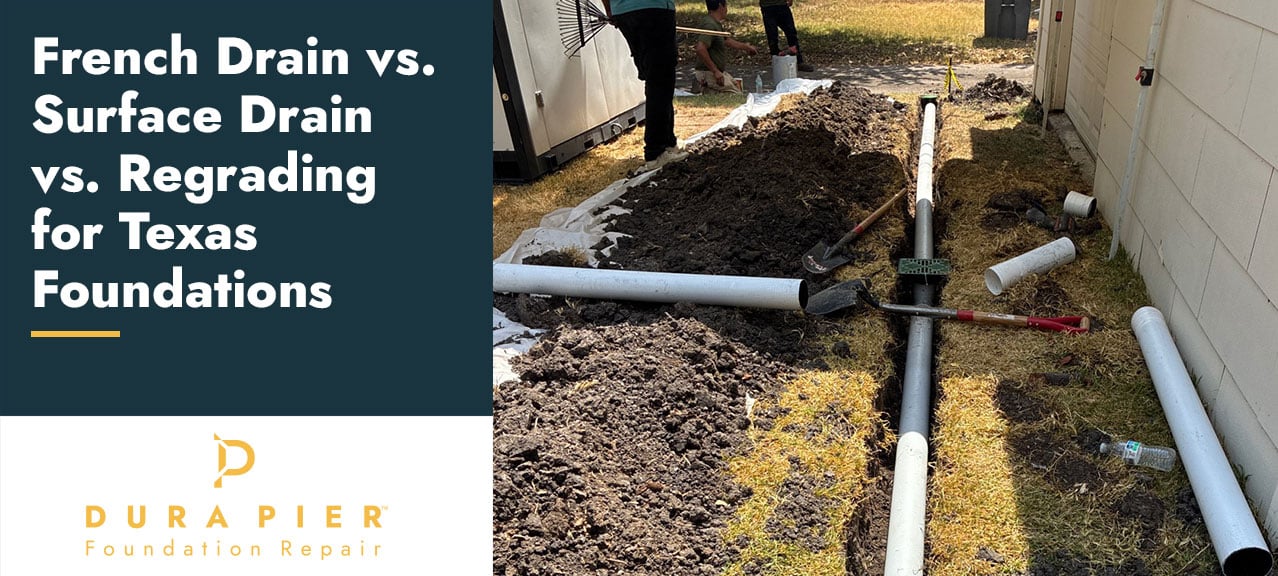
You walk outside after a heavy rain and there it is again—water standing in your yard near the house, or soil that stays soggy for days while the rest of the lawn dries out. You know something needs to change, but when you start looking into solutions, you hear about French drains, surface drains, and regrading, and it’s not always clear which one fits your situation. Here’s what matters: these three fixes solve different problems, and choosing the wrong one can cost you money without actually fixing anything. At Dura Pier Foundation Repair, we help Houston and DFW homeowners figure out where their water is coming from and where it needs to go, so the solution actually works.
Why Drainage Matters for Texas Foundations
Texas sits on expansive clay soil that swells when it gets wet and shrinks when it dries out. When moisture levels around your foundation stay uneven—wet on one side, dry on another—that movement in the soil can contribute to foundation shifting. The goal isn’t to keep the soil bone-dry around your home; it’s to maintain consistent moisture levels so the ground isn’t constantly expanding and contracting. Water pooling around foundation walls is the most common cause of foundation problems in Texas, which is why getting drainage around foundation Texas homes right matters so much. We’ll link to our detailed post about Texas clay soil if you want the full explanation, but the short version is this: managing water around your foundation protects your home’s structure.
Start Here: Is It a Surface Problem or a Below-Ground Problem?
Before you compare methods, it helps to understand what kind of water problem you’re dealing with. Water you can see pooling or running across your yard is a surface problem. Soil that stays wet with no visible water source suggests a below-ground issue. Sometimes what looks like a drainage problem is actually a plumbing leak under the slab, which is why a thorough evaluation should rule that out—we have a post about hydrostatic plumbing tests that explains how that works.
Here’s the simplest first check: look at your gutters, downspouts, and downspout extensions. Municipal guidance recommends that gutters and downspouts should direct water away from houses, ideally into vegetated or graveled areas for filtration before leaving the property. If your downspouts dump water right next to your foundation, extending them away from the house might solve your problem without any excavation at all.
What Is Surface Drainage and When Do You Need It?
A surface drainage system captures water that flows across your yard before it can pool against your foundation. These systems typically include catch basins or channel drains—you’ll see them as grated inlets in the ground—connected to solid pipe that carries water to a discharge point away from your home. A surface drain for yard applications works at ground level, intercepting runoff before it becomes a problem.
Surface drains work well for specific situations. If you have low spots in your yard where water collects, a surface drain channel can capture that water and move it along. They’re effective for managing downspout runoff when extensions alone aren’t enough, and they handle water from patios and walkways that slope toward the house. Installing a surface drainage system typically takes one to three days for most residential properties.
The limit of surface drains is that they only address water you can see flowing across the ground. If your soil stays saturated because water is moving through it below the surface, a surface drain won’t help with that. They’re excellent at what they do—moving visible runoff away from your foundation—but they’re not designed to handle subsurface moisture.
Regrading: Changing Which Way Water Flows
Regrading yard for foundation drainage means reshaping the soil around your home so the ground slopes away from your foundation instead of toward it. It’s a straightforward concept: water follows gravity, so if the ground tilts away from your house, water flows away too. Yards should slope gently away from homes to prevent water accumulation near foundations, and municipal guidance encourages residents to preserve this grading to ensure water drains away effectively.
This approach works well when your yard actually slopes toward the house, or when flower beds have been built up against the slab over time, creating a dam that holds water against your foundation. The International Residential Code includes requirements for ground to fall away from foundations—we verify the current local adoption and exact requirements for Houston and Fort Worth before any work begins.
Regrading has limits, though. On tight lots or very flat properties, there might not be enough space or elevation change to create effective slope. Changing your yard’s grade can also affect how water flows onto neighboring properties, which means you need to think about where that water will go. Before installing drains, consider whether regrading yard for foundation drainage might solve the problem on its own—it’s often the most straightforward fix when the issue is simply that water flows the wrong direction.
Foundation French Drain: Intercepting Water Below Ground
A foundation french drain works below ground to intercept subsurface water before it reaches your home. The system consists of a gravel-filled trench with perforated pipe that collects water moving through the soil and carries it away to a discharge point. Many people call any yard drain a “French drain,” but technically, French drains are specifically subsurface systems that handle water in the soil rather than surface runoff.
The foundation french drain installation requires proper slope to ensure water flows continuously toward the discharge point. Here’s a critical point from drainage professionals: a French drain without consistent slope holds water instead of moving it, which is worse than no drain at all. That standing water in a poorly installed drain can actually create new problems.
French Drain for Clay Soil: Special Considerations in Texas
Installing a french drain for clay soil requires careful design because water moves slowly through clay. The fabric that lines the trench, the type of gravel used, and the slope of the pipe all matter more in clay soil than they would in sandy or loamy soil. Water doesn’t percolate quickly through Texas clay, so the system needs to account for that slower movement. The curtain drain vs french drain comparison often comes down to placement and specific water interception goals—both are subsurface systems, but they’re positioned differently based on where water needs to be intercepted.
French drains involve more excavation than surface solutions, which means more disruption to your landscaping. Trenching for drainage systems can leave visible lines across lawns, though proper backfilling and grade restoration minimize long-term aesthetic impact. You’ll also need a viable discharge point—somewhere the water can go once the drain collects it. Most residential drainage jobs run one to three days, though larger systems or challenging discharge situations may require more time.
While a french drain for surface water can work in some situations, surface drains are typically more efficient for runoff. The french drain vs surface drain decision depends on whether your water problem is above or below ground, and many drainage projects require both solutions—it’s not always an either-or choice.
Side-by-Side Comparison
Here’s how the three methods stack up against each other:
| Factor | Surface Drain | Regrading | French Drain |
|---|---|---|---|
| Problem it addresses | Visible runoff and pooling | Ground sloping toward the house | Water held in the soil |
| Where it works | At the surface | Across the yard grade | Below ground |
| Installation timeline | 1-3 days typical | 1-3 days typical | 1-3 days typical; larger systems may take longer |
| Yard disruption | Trenching for pipe runs; catch basin installation | Soil removal and reshaping; may affect landscaping | Most excavation; visible trench lines initially |
| Maintenance needs | Keep inlets and grates clear of debris | Monitor for settling; maintain slope over time | Check discharge points; verify continued flow |
| Best for | Low spots, downspout runoff, patio drainage | Yards sloping toward house; built-up flower beds | Subsurface moisture; clay soil water retention |
Many homes need a combination of these methods. An evaluation determines the right mix for your property—there’s rarely a single solution that handles every water issue.
Drainage Around Foundation Texas: Regional Factors That Matter
Houston vs. DFW: What Changes
Houston faces frequent heavy rain, flat terrain, and slow-draining soils, which makes discharge points a key design question. Where does the water go when your property doesn’t have much natural slope? Richardson’s stormwater system, for example, includes 362 miles of underground storm drain lines designed to manage rainfall and direct water to drain lines and creek beds. In urban areas, municipal storm drain infrastructure may provide discharge options, but you’ll need to verify local rules about discharging to the street or curb.
DFW deals with expansive clay and long dry spells followed by heavy rain. That cycle of wet and dry creates the soil movement that can contribute to foundation issues. The approach to drainage around foundation Texas properties differs between these regions because the soil, rainfall patterns, and terrain aren’t the same.
Both markets have city or HOA rules about where you can discharge water, and those regulations matter when you’re planning a drainage system. We verify local requirements before designing any system, and we can show you before-and-after photos from projects in your area.
Drainage and Foundation Repair: How They Work Together
Drainage work is often part of a foundation repair plan, but it’s not a substitute for repair when movement has already occurred. If your foundation has shifted, installing drains won’t reverse that damage—you’ll need foundation repair to address the existing problems. On the flip side, foundation repair may not hold up well if water problems remain. The two work together: repair fixes what’s already happened, and drainage prevents it from happening again.
Most drainage problems are solvable in a day or two for a fraction of what foundation repair costs. That’s why addressing drainage early makes financial sense. If you’re looking at foundation repair costs, we have detailed posts about foundation repair cost in Texas and pier and beam foundation repair cost that break down what to expect.
Root barriers are a separate tool for tree-related moisture loss—if trees near your foundation are pulling moisture from the soil unevenly, that’s a different issue that drainage alone won’t solve. We have a post about root barriers that explains how they work.
What Happens During a Drainage Evaluation
Here’s what you can expect when we evaluate your property:
Property Walk: We walk your property, ideally after or during rain when possible, to see where water actually flows and collects. Seeing water in action tells us more than looking at dry ground.
System Check: We check your gutters, downspouts, and current grading to identify simple fixes that might solve the problem without major work.
Low Spot Identification: We identify where water pools and figure out viable discharge options—where can the water go once we collect it?
Leak and Movement Check: We look for signs of plumbing leaks or foundation movement, because those issues need different solutions than drainage work.
Written Recommendation: You’ll get a written recommendation with scope and price, so you know exactly what we’re proposing and what it will cost.
Homeowners can actually control where water goes through proper drainage system design and implementation. The evaluation figures out how to make that happen on your specific property.
Frequently Asked Questions
Do French drains work in clay soil?
Yes, but design matters more in clay than in other soil types. A french drain for clay soil needs proper slope, appropriate fabric to prevent clogging, and the right gravel to allow water movement despite clay’s slow percolation. The foundation drain vs french drain terminology can be confusing—both are subsurface systems, but foundation drains are specifically placed around the foundation perimeter, while French drains can be located anywhere on the property where subsurface water needs to be intercepted. Poor installation in clay soil can make problems worse, which is why working with professionals who understand Texas soil conditions matters.
Can I regrade my yard myself?
You can, but there are important considerations. You need to know where the water should go, how much slope is required, and how your grading changes will affect neighboring properties. You’ll also want to verify that you’re not covering foundation vents or creating new low spots. Small adjustments might be manageable, but significant regrading typically requires equipment and expertise to get the slope right and ensure water flows where it should.
Where does the water go?
That’s one of the most important questions in drainage design. Water needs a discharge point—somewhere it can go without causing problems. Options include vegetated or graveled areas on your property, natural drainage corridors, or municipal storm drain systems where permitted. The perimeter drain vs french drain comparison often comes down to where water can be discharged—both collect subsurface water, but the discharge location determines which design works better. During extreme weather events, even properly designed systems may experience temporary water accumulation, but the goal is to move water away from your foundation during typical rainfall.
Do I need a permit for drainage work in my city?
Permit requirements vary by city and by the scope of work. Some municipalities require permits for drainage systems that discharge to streets or connect to storm drains, while others have different thresholds. We verify current permit requirements in Houston and Fort Worth before starting any project, so you don’t have to worry about compliance issues.
Will a drain stop my foundation from moving?
Proper drainage can help maintain consistent moisture around your foundation, which reduces the soil movement that can contribute to foundation problems. However, if your foundation has already shifted, drainage won’t reverse that damage—you’d need foundation repair for existing issues. Think of drainage as prevention and protection rather than a repair method. It addresses the water problems that can contribute to foundation movement, but it’s not a substitute for structural repair when damage has already occurred.
Schedule Your Drainage Evaluation Today
Water problems around your foundation don’t fix themselves, and waiting typically means more expensive repairs down the road. Whether you’re dealing with standing water, soggy soil, or runoff that flows toward your house, Dura Pier Foundation Repair can help you figure out which solution fits your property. We’ll walk your property, identify where the water is coming from and where it needs to go, and give you a written recommendation with clear pricing.
We serve Houston and DFW, and we understand the drainage challenges that come with Texas clay soil and our regional weather patterns. Call us to schedule a drainage or foundation evaluation—let’s get your water flowing in the right direction.
Ready to solve your drainage problems? Contact Dura Pier Foundation Repair today for a professional evaluation.