
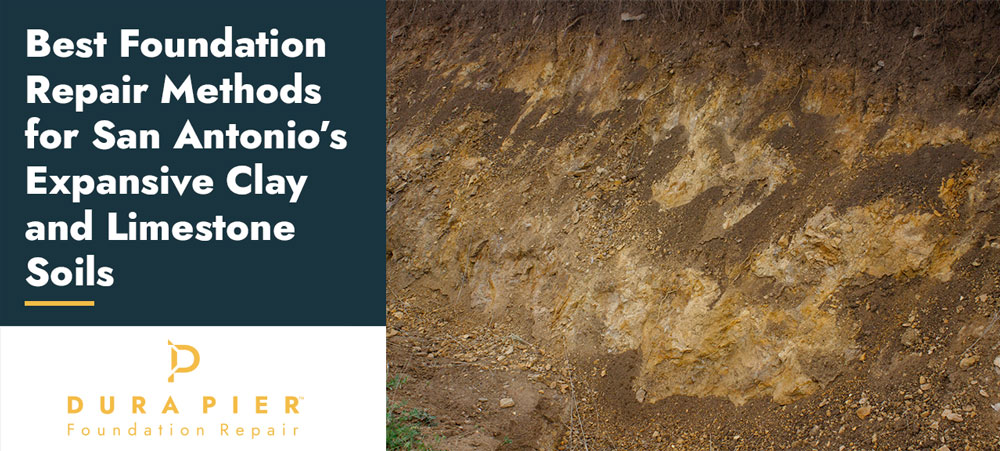
Foundation repair isn’t a one-size-fits-all business, and nowhere is that more apparent than in San Antonio. The geology beneath Bexar County is more varied than most Texas cities, a mix of expansive clay, shallow limestone, and transition zones where the two meet beneath the same slab. The repair method that works well in one San Antonio neighborhood may be a poor choice two miles away. Getting that decision right matters, because the wrong approach in the wrong soil conditions can mean repairs that don’t hold.
This guide explains how the most common foundation repair methods perform in San Antonio’s specific soil and bedrock conditions, so you can ask better questions and make a more informed decision when the time comes.
Why Soil Conditions Drive the Method Choice
Before getting into the methods themselves, it’s worth understanding why soil type is so central to the decision. Foundation repair works by transferring the load of your home from unstable, shallow soil down to a more stable bearing point. The method used determines how deep you can go, how much load each support point can carry, and how it will perform as the surrounding soil continues to move through seasonal cycles.
In San Antonio, the answer to “how deep is stable?” depends heavily on where you are. In parts of the city where limestone bedrock is relatively close to the surface, reaching that bedrock gives you a very reliable endpoint. In areas with deep clay profiles, stability comes from reaching soil that’s deep enough to be unaffected by surface moisture fluctuations. The two conditions call for different approaches.
Pressed Concrete Piers
Pressed concrete piers, sometimes called pressed pilings, are among the most common foundation repair method used in San Antonio and throughout South Texas. The process involves hydraulically pressing short cylindrical concrete cylinders into the ground beneath the foundation until they reach adequate resistance. The resistance point serves as the bearing depth for that pier location.
This method works well in San Antonio’s clay soils where the material compresses predictably and provides consistent resistance at depth. It’s a proven approach with a long track record in the Texas market, and it tends to be one of the more cost-effective options for standard residential slab repair.
The limitation is that pressed piers rely on skin friction and end bearing in soil, which means they can be affected in extreme drought conditions when deep clay shrinkage occurs. In areas with very inconsistent soil profiles, or where limestone is present at irregular depths, the resistance readings can be harder to interpret accurately.
Steel Push Piers
Steel push piers work on a similar principle to pressed concrete piers but use steel pipe sections driven in sequence rather than concrete cylinders. Like pressed piers, they’re advanced hydraulically and rely on resistance readings to determine the bearing depth.
Steel push piers can generally reach greater depths than pressed concrete piers, which makes them a useful option in San Antonio neighborhoods where the clay profile is deeper and more consistent. The steel material also performs differently in wet soil conditions than concrete cylinders do.
One consideration for San Antonio specifically is that steel piers driven in soils with variable moisture content can be subject to movement in the upper portion of the installation, even when the bottom of the pier is at depth. Good installation practice addresses this, but it’s worth discussing with your contractor how they account for it.
Helical Piers
Helical piers are steel shafts with helical plates that are torqued into the ground rather than pushed. The torque required to advance the pier is a direct measure of the load capacity at that depth, which gives installers precise data on bearing performance.
For San Antonio homes situated on or near limestone, helical piers are often the preferred method. They can advance through the transition zone between clay and rock more predictably than push-type piers, and they can achieve bearing in fractured limestone in a way that compressed concrete cannot. They also work well in tight access situations, such as along interior walls or under additions, because the installation equipment is more compact.
Helical piers tend to be more expensive per pier than pressed concrete options, but in the right soil conditions they offer a level of verified load capacity that other methods can’t match.
Drilled Concrete Piers (Bell-Bottom Piers)
Bell-bottom piers involve drilling a deep shaft into the ground, sometimes 10 to 20 feet deep, and then enlarging the base of the hole into a bell shape before filling it with concrete. The enlarged base distributes the load over a wider area and provides excellent uplift resistance, meaning the pier resists not just downward load but also the upward movement that expansive clay can exert.
This method is particularly well-suited for the portions of San Antonio where expansive clay soils are deep and the primary concern is both settlement and uplift. The bell base anchors the pier against the clay’s tendency to push upward when it swells after rain.
Bell-bottom piers are a larger-scale repair method, typically used in situations where other approaches have limitations, or when the soil profile and structural conditions call for a higher-capacity solution.
Choosing the Right Method for Your San Antonio Home
The right repair method for your specific situation depends on several factors working together:
- The soil profile beneath your home — clay depth, limestone proximity, and how variable the conditions are across your lot
- The type of foundation movement you’ve experienced — settlement, upheaval, or differential movement involving both
- The location of affected areas — perimeter only, interior, or a combination
- The accessibility of the work areas — tight crawl spaces, close property lines, or landscaping constraints
- The severity of the movement and whether any underlying drainage or plumbing issues need to be addressed alongside the structural repair
No reputable contractor should recommend a specific method without first understanding what’s happening beneath your home. That means a proper evaluation includes not just a visual inspection of interior cracking and floor levels, but an assessment of the surrounding soil conditions, drainage patterns, and in some cases, the plumbing system.
At Dura Pier, every evaluation for a San Antonio home accounts for the specific soil and bedrock conditions in that neighborhood. The repair approach we recommend is based on what will actually work long-term in those conditions, not what’s most convenient to install.
If you’re dealing with foundation movement in San Antonio, or if you want to understand what’s happening before it progresses further, a free professional evaluation is the right starting point. We serve homeowners across Bexar County and the surrounding communities.