Houston, TX Foundation Repair Contractors
Greater Houston sits on some of the most active clay soil in the country. It swells when it rains, shrinks when it dries, and does that every single year. Dura Pier of Houston handles foundation repair, concrete leveling, sewer line repair and drainage across the metro from our Player Street office. We use floor elevation readings to find out what a house is actually doing before recommending a repair, and every job is backed by our Dura Lock XD® piling system and a lifetime transferable warranty.
Request a Free Estimate
Start with a free, no-obligation evaluation from one of our local experts.
"*" indicates required fields
Tailored Foundation Repair Solutions for the Greater Houston Region
Houston homes deal with two problems at once. The ground swells and shrinks with the seasons, and it drains slowly enough that water sits where you do not want it. Those two things together are why foundation trouble here is so common, and why a fix that only addresses one of them does not last.
Our approach is the same whether you have a slab or a raised pier-and-beam floor. Elevation readings show us where the house has actually moved, and the repair gets built around those numbers. Sometimes that means piers. Sometimes it means fixing where water goes. Often it means both.
Service Area
Serving Houston, Texas and the surrounding areas
With offices in major Texas cities, we’re never far when you need us. Each market has specialists who understand local soil and structural challenges.
Houston Service Area
- Baytown, TX
- Bellaire, TX
- Conroe, TX
- Cypress, TX
- Deer Park, TX
- Friendswood, TX
- Katy, TX
- League City, TX
- Missouri City, TX
- Pasadena, TX
- Pearland, TX
- Richmond, TX
- Spring, TX
- Sugar Land, TX
- The Woodlands, TX
- Tomball, TX
The Dura Pier Advantage: Engineered Precision & Lasting Value
Investing in structural foundation work requires complete trust in your contractor’s engineering capability, warranty backing, and field experience. Homeowners across Greater Houston depend on Dura Pier because we hold our work to the highest standards in the industry.
- Exclusive Dura Lock® Piling Technology: Our patented piling system features interlocking alignment rods that guarantee vertical alignment as pilings are driven deep into load-bearing strata far below volatile surface soil.
- Consultative, No-Pressure Assessments: We provide transparent evaluations backed by precise floor elevation measurements, explaining the physics behind your structural movement without high-pressure sales tactics.
- Lifetime Transferable Warranty: Our structural piling installations are protected by a true lifetime warranty that transfers seamlessly to future homeowners, preserving your property’s resale value.
- Dedicated, In-House Installation Teams: Every project is completed by our own trained, experienced installation crews who operate under strict supervisory standards and strictly follow municipal building codes.
We don’t cut corners. We don’t use scare tactics. We earn your trust through expert work and neighborly care.
Foundation Repair in Houston
When you need reliable foundation repair in Houston, addressing the underlying soil conditions is essential for a lasting solution. Expansive clay soils across Greater Houston swell rapidly during heavy rains and shrink drastically during hot summer dry spells, placing continuous stress on residential and commercial structures.
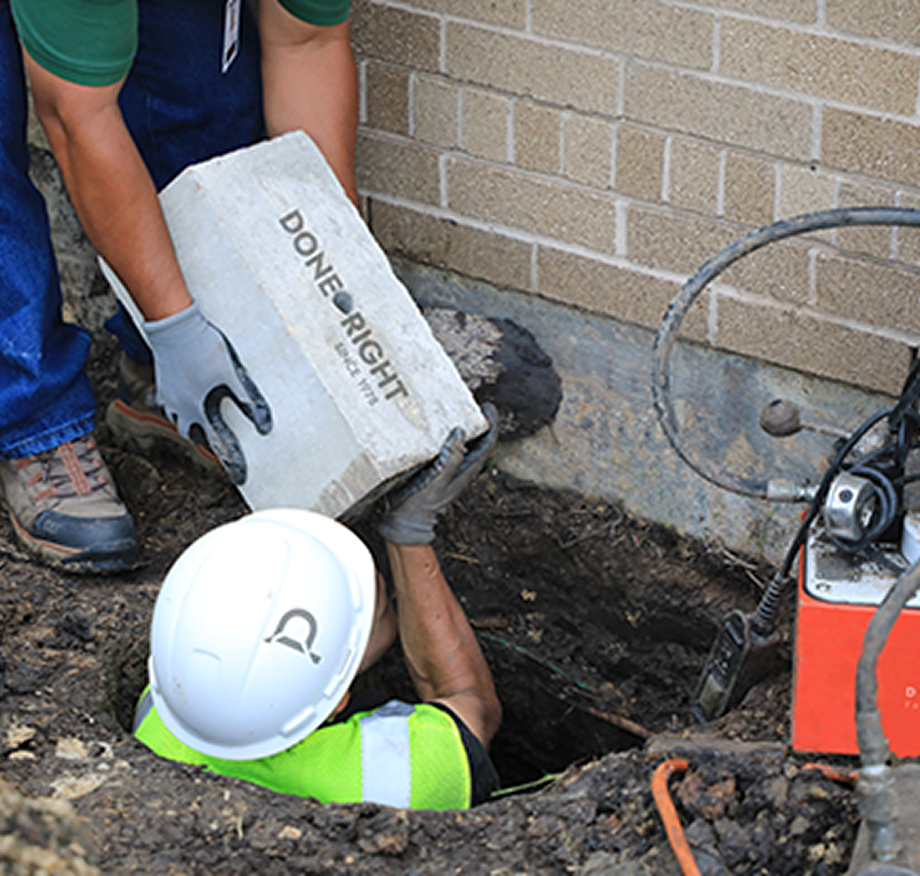
- Dura Lock® Piling Systems: We drive heavy-gauge steel pilings or interlocking concrete piers deep past volatile surface clay down to stable, load-bearing strata.
- Comprehensive Structural Stabilization: Our multi-point hydraulic jacking systems carefully raise settled concrete slabs and pier-and-beam foundations back toward their original elevation.
- Permanent Soil Protection: By transferring your home’s weight onto deep-seated strata, we eliminate recurring movement caused by shifting ground conditions.
Concrete Lifting in Houston
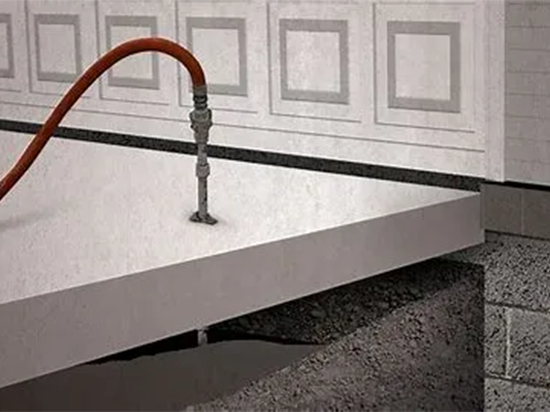
Our advanced concrete lifting in Houston provides a fast, non-invasive alternative to complete concrete replacement. Sunken driveways, uneven sidewalks, sagging pool decks, and tilting patio slabs create serious tripping hazards and allow rainwater to pool directly against your foundation.
- High-Density Polyurethane Injection: We inject expandable, commercial-grade polymer foam through micro-drilled holes to cleanly raise settled slabs.
- Subterranean Void Filling: The expanding foam fills empty pockets beneath the concrete, consolidating loose subgrade soil to establish a uniform supporting base.
- Minimal Downtime & Cost Efficiency: The eco-friendly polymer cures within minutes, allowing immediate foot and vehicle traffic without the mess of major demolition.
Sewer Line Repair in Houston
Executing precise sewer line repair in Houston is critical when plumbing leaks threaten the soil stability beneath your slab. Undetected leaks in drain pipes buried underneath concrete foundations cause localized soil swelling or wash away supporting earth, leading to severe structural settlement.
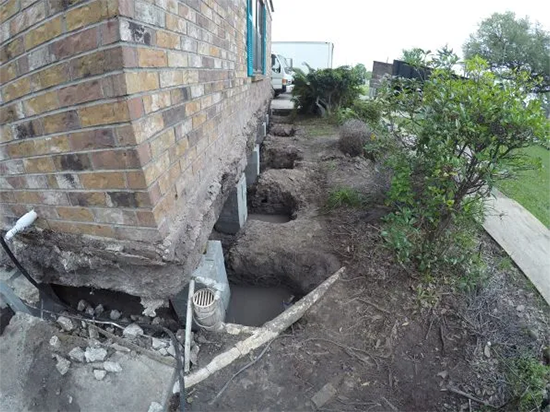
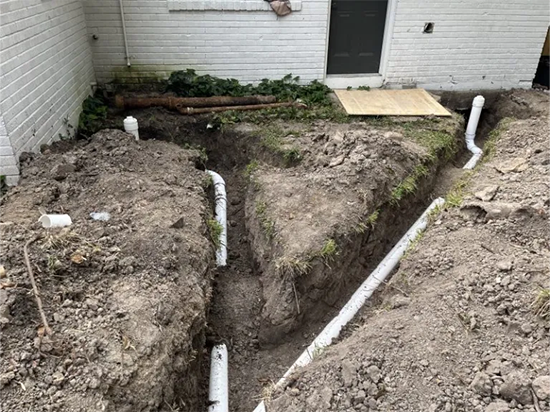
- Subterranean Tunneling: We excavate horizontal access tunnels under your slab to reach damaged pipes, preserving your interior flooring, tile, and carpet.
- Schedule 40 PVC Replacement: Corroded cast iron or cracked drainage lines are replaced with heavy-duty PVC engineered to withstand soil shifting and root intrusion.
- Diagnostic Precision: High-definition camera inspections and hydrostatic testing isolate exact break points before excavation begins, ensuring targeted, efficient repairs.
Drainage Solutions in Houston
Houston has been through three 500-year storms in three years. Memorial Day 2015, Tax Day 2016, and Harvey in August 2017. In one 13-month stretch starting in May 2015, this area saw six separate flood events that dropped more than eight inches of rain. Nothing that dramatic has to happen to hurt a foundation, though. On flat ground with slow-draining clay, an ordinary heavy rain is enough to leave water standing against your slab for days. Getting that water off your lot is the cheapest foundation protection you can buy.
- French Drain Systems: Subsurface perforated piping wrapped in filter fabric collects groundwater and redirects it safely away from your home’s grade beams.
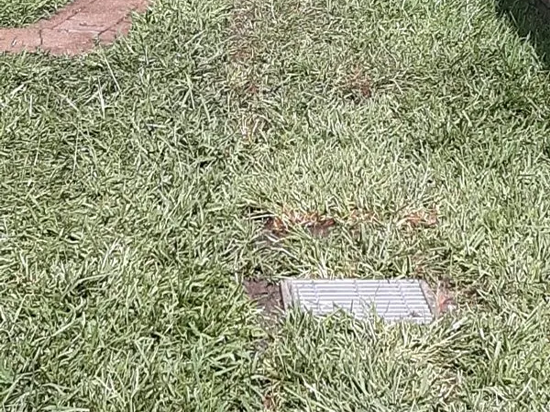
- Surface Catch Basins & Channel Drains: Strategic surface drains capture heavy downspout runoff and low-spot water before it can pool near your foundation.
- Yard Grading: Precision re-contouring of your lawn establishes proper slope away from the home, eliminating low spots and preventing rainwater from collecting along your perimeter slab.
The Technology Behind Stronger Foundations
Most foundation repairs rely on generic pier systems.
Dura Lock® is different.
Standard pier systems underperform in Houston’s Beaumont Formation clay because the ground never stops working against them. A piling that simply rests in place gets nudged out of position over enough wet and dry cycles. Our Dura Lock XD® system uses bolted segments that are driven and held in tension, so the column stays where we put it instead of drifting with the soil. Our proprietary Dura Lock® and Dura Lock XD® systems feature bolted segments driven and tensioned for superior grip, vertical alignment, and long-term resistance to both deep downward settlement and moisture-driven heave.
Key advantages include deeper penetration past volatile coastal clay layers, stronger inter-segment connections to withstand high hydrostatic pressure, efficient installation with minimal lawn disruption, and permanent performance backed by our lifetime transferable warranty. This technology reflects decades of refinement specifically engineered for Greater Houston’s unique soil and climate conditions.
Houston Foundation Repair FAQs
How do I know if my foundation is really moving?
Measurement is the only reliable answer. Some settling is normal in a home’s first year or two, and thin shrinkage cracks in a slab are ordinary. Real movement shows a pattern: cracks that widen over months, doors that stick in one season and free up in another, and floor elevations that vary more than construction tolerance. One set of readings gives you a baseline.
What does foundation repair cost in Houston?
It depends on how many piers your home needs, how deep they have to go, and whether drainage work is part of the job. Across the Houston area, moderate repairs commonly land in the low-to-mid thousands, and whole-house corrections with drainage run higher. Anyone quoting a price over the phone is guessing. Our on-site evaluation is free.
How long does the work take?
Most single-family pier jobs take a few days of actual work. Tunneling under a slab, larger homes and drainage work take longer. The calendar window is always wider than the working days because it includes scheduling, any permit, and the plumbing test after the lift. You get a date range in writing before we start.
Do I need a structural engineer first?
Not on every job. In Texas, only a licensed professional engineer can issue an engineering evaluation of a structure. A contractor cannot. That report is worth getting when movement is severe, when a lender or insurer asks for one, or when you want an opinion from someone with no stake in the repair. We work from engineer plans often.
Did the flooding damage my foundation?
Usually not directly, though the two get confused. Water inside the house damages floors, walls and framing. Foundation movement comes from what the soil does underneath. Long saturation followed by a hard dry-out is exactly the cycle that moves clay, so homes that took water in 2015, 2016 and again during Harvey went through it more than once.
Does homeowners insurance cover this?
Rarely, when soil movement is the cause. Texas policies generally cover sudden and accidental damage. Gradual settling from clay shrinking and swelling is usually treated as maintenance. A sudden plumbing leak under the slab is sometimes handled differently. Read your exclusions and call your carrier before you count on coverage.
Should I water my foundation in the summer?
Yes, and steady beats heavy. The goal is keeping the soil around your perimeter evenly damp so the clay never opens up on one side of the house while the other stays wet. A soaker hose set back about a foot from the slab, run on a timer, does more good than an occasional deep soaking.
Do you check the plumbing after lifting my house?
We recommend a hydrostatic test after any real lift. Raising a slab puts stress on the drain lines underneath it, and older Houston homes often have cast iron drain lines that have been in the ground for decades. Finding a break right away costs far less than finding it through a wet spot next spring.
What Our Customers Are Saying
Recognized for Service, Trusted by Homeowners