
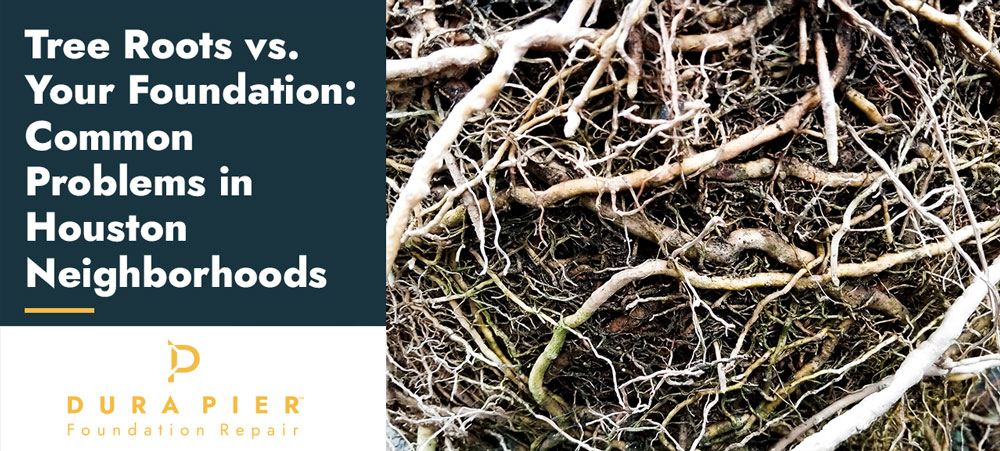
Trees add shade, curb appeal, and value to Houston properties, but they can also create foundation problems if they are planted too close to the home. Tree roots do not usually “push” a foundation upward the way many homeowners imagine, but they can affect the soil moisture around the home and contribute to settlement or movement.
In Houston neighborhoods with large mature trees, especially in older areas and tree-lined streets, foundation problems leading to foundation repair in Houston can become more common over time. The issue is not usually the roots themselves, but how they change the moisture balance in the soil beneath and around the foundation.
How tree roots affect foundations
Tree roots spread outward in search of water and nutrients. In Houston’s clay-heavy soil, that can become a problem because the roots may pull moisture from the soil near the home.
When that happens:
- Soil shrinks.
- The foundation can lose even support.
- One part of the home may settle faster than another.
- Cracks and sticking doors may appear.
This is especially concerning during dry weather, when roots compete even harder for moisture.
Common problems homeowners notice
The signs of tree-related foundation issues often look similar to other foundation problems. Homeowners may notice:
- Cracks in interior walls or ceilings.
- Sloping floors.
- Sticking doors or windows.
- Gaps between the wall and trim.
- Cracks in exterior brick or mortar.
- Uneven settlement near one side of the house.
If these issues appear closest to a large tree, that may be a clue that tree-root activity is contributing to the problem.
Neighborhood factors that make it worse
Some Houston neighborhoods are more vulnerable because they have older homes, larger trees, or long periods without major landscaping updates. In many cases, the problem develops slowly over years.
The risk is higher when:
- A large tree is planted near the foundation.
- Several trees are concentrated in one part of the yard.
- The home is built on clay soil.
- The property has poor irrigation or drainage.
- The home already has signs of settlement.
Tree roots are not always the main cause, but they can make existing foundation issues worse.
How to tell if trees are part of the problem
If you suspect tree roots may be affecting your foundation, look for these clues:
- Cracks are more visible on the side closest to the tree.
- The soil around the tree is dry and pulling away.
- Doors or floors seem worse during hot, dry periods.
- The problem improves slightly after rain, then gets worse again.
- The tree is large and mature, with roots likely extending far beyond the trunk.
A foundation inspection can help determine whether the issue is tree-related, moisture-related, or both.
What homeowners can do
If you have large trees near your home, you do not always need to remove them. In many cases, good moisture management and monitoring can help reduce the risk of serious foundation damage.
Helpful steps include:
- Water the soil consistently during dry periods.
- Avoid letting the soil get extremely dry next to the home.
- Keep large trees at a safer distance from the foundation when possible.
- Watch for recurring settlement signs.
- Have the foundation inspected if cracks or movement worsen.
When to call for help
If the cracks are growing, the floors are getting more uneven, or the doors and windows are no longer working correctly, it is time to have the home evaluated. Tree roots may be part of the issue, but a foundation professional can tell you whether repair is needed.
Closing CTA
If you think tree roots may be affecting your Houston foundation, contact Dura Pier Foundation Repair to schedule an inspection and find out what is causing the movement.