
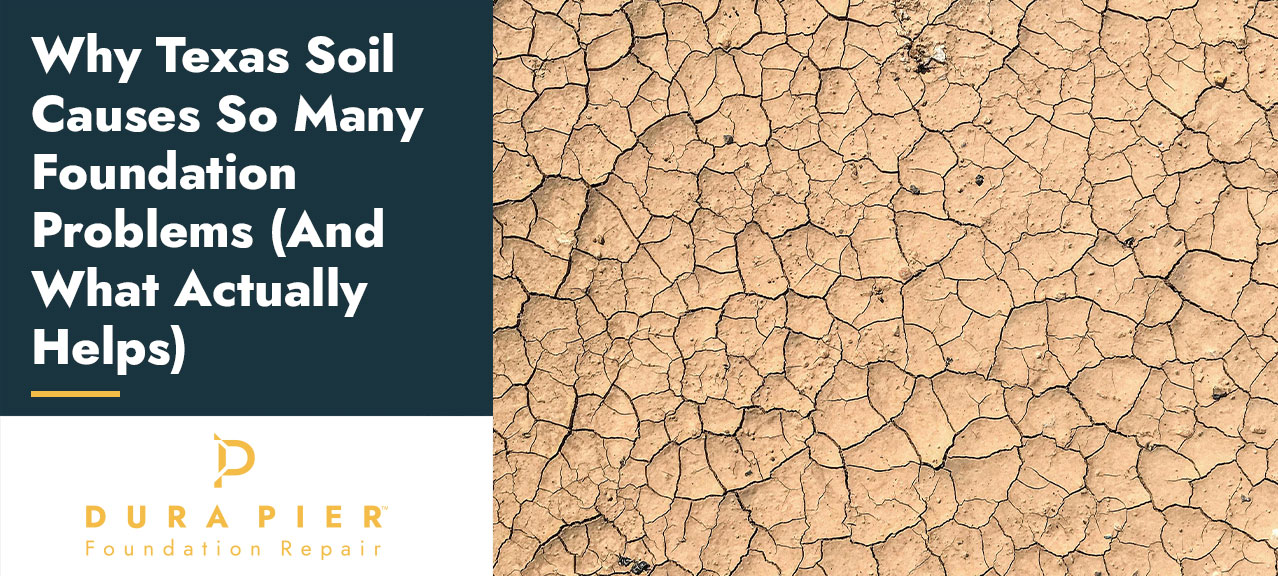
If you’ve ever talked to a Texas homeowner about foundation issues, you’ve probably heard the word “clay” come up within the first thirty seconds. That’s not a coincidence. Texas sits on some of the most expansive, reactive clay soil in the entire country, and it is the single biggest reason foundation movement is so common across Houston, Dallas-Fort Worth, Austin, San Antonio, and every city in between.
But “clay soil is the problem” is about as useful as saying “weather causes flooding.” It’s true, but it doesn’t explain what’s actually happening beneath your home, why it affects some properties more than others, or — most importantly — what you can actually do about it.
After 45+ years of repairing foundations across Texas, Dura Pier Foundation Repair has seen every variation of clay-related foundation damage there is. Here’s the real story — and what actually works.
What Makes Texas Clay So Problematic
Not all clay soil behaves the same way, and Texas happens to be home to some of the most active clay in the world. The dominant soil type across much of central and eastern Texas is called Vertisol — a category of soil defined specifically by its extreme shrink-swell behavior. In the Houston area it’s commonly called Houston Black Clay. Across the DFW Metroplex and Central Texas, it runs as the Blackland Prairie, one of the most recognizable and most challenging soil belts in North America.
What makes these soils so difficult for foundations comes down to their mineral composition. Expansive clays are rich in a mineral called montmorillonite, which has an unusual molecular structure that allows it to absorb water molecules between its layers and physically swell as a result. When the same clay dries out, those water molecules leave, and the clay contracts.
The numbers tell the story. Texas Vertisols can expand by 30 percent or more in volume when saturated — and shrink back almost as dramatically when dry. For context, that means the soil immediately surrounding and beneath your foundation is physically changing size with every rain and every drought. Over and over, season after season, year after year.
Your foundation wasn’t designed for that kind of movement. No foundation is.
The Shrink-Swell Cycle: How the Damage Actually Happens
Understanding the shrink-swell cycle is the key to understanding why Texas foundations move the way they do — and why the damage is often uneven across a single property.
During wet periods, the clay beneath and around your foundation absorbs water and expands. This expansion pushes upward against the slab and outward against any below-grade walls. In areas where water concentrates — near downspouts, along fence lines, at the base of the home’s perimeter — the clay absorbs more moisture than elsewhere, and the expansion is greater in those spots. The result is that different sections of your foundation are being pushed up by different amounts at the same time.
During dry periods — and Texas droughts can be severe and prolonged — that same clay loses moisture and contracts. It shrinks away from the foundation, pulling back from surfaces it was supporting and creating voids beneath the slab. The edges of the foundation, which are most exposed to evaporation, dry out faster than the center. The center of the slab, protected by the home above it, holds moisture longer. This creates a classic domed condition where the center sits higher than the perimeter — what foundation specialists call “center lift.”
Then the rain comes back, and the cycle reverses.
It’s this constant, uneven movement — different parts of the foundation responding to moisture at different rates and in different directions — that cracks slabs, distorts door frames, separates interior drywall at the corners, and eventually causes the kind of structural displacement that requires professional repair.
Why Some Homes Are Hit Harder Than Others
Two houses on the same street can have dramatically different foundation experiences, and homeowners are often puzzled by this. The reasons come down to a few key variables.
Drainage and water management is the most influential factor. A home where water pools near the foundation after rain — whether because of poor yard grading, inadequate gutters, or landscaping that traps moisture against the slab — is constantly feeding the wet side of the shrink-swell cycle. The soil around that home experiences far more extreme moisture fluctuation than a home where water is efficiently moved away from the foundation.
Tree placement and root systems play a larger role than most homeowners realize. The root systems of large trees draw enormous amounts of moisture from the surrounding soil, creating localized dry zones that accelerate clay shrinkage in specific areas. A mature oak tree planted too close to the foundation can create a persistent dry pocket in the soil on that side of the home — causing that corner or edge to settle while the rest of the foundation stays in place.
Foundation age and original construction quality matter as well. Homes built decades ago were often designed to less stringent standards for Texas soil conditions. Post-tension slab design, which accounts for the forces generated by expansive soil, became more common in Texas residential construction over time. Older conventional slabs, particularly those without adequate reinforcement for the specific soil loads present on the site, tend to show more significant movement over their lifetimes.
Lot position and soil depth vary even within a single neighborhood. Areas with deeper clay deposits are more vulnerable than areas where the clay layer is shallower and transitions sooner to more stable material.
The Warning Signs You’re Seeing (And What They Mean)
Clay-related foundation movement produces a consistent set of symptoms, and most Texas homeowners encounter them eventually. Here’s what the most common ones actually indicate.
Interior drywall cracks at door and window corners are typically the first sign most homeowners notice. These diagonal cracks follow the direction of stress in the wall as the foundation beneath shifts. They’re not random — they appear at the weakest points in the drywall assembly, which are the corners of openings.
Doors and windows that stick or won’t close flush indicate that the opening has been distorted by foundation movement. A door frame that was once a precise rectangle becomes a slightly skewed parallelogram as the foundation beneath it shifts, and the door no longer fits correctly. This is particularly common after extended dry seasons in the Texas area.
Gaps between walls and ceilings or floors indicate that different parts of the structure are moving independently. The foundation beneath one wall is settling or lifting at a different rate than the foundation beneath the adjacent wall, and the gap is the visible result.
Sloping floors — floors that feel like they have a slight but persistent tilt — indicate that one section of the foundation has settled or lifted relative to another. This is one of the more advanced presentations and generally indicates movement that has been ongoing for some time.
Exterior brick cracks in a stair-step pattern follow mortar joints in the diagonal pattern that results from the racking stress caused by differential settlement. They’re a reliable exterior indicator that the foundation beneath that section of wall has moved.
What Actually Helps — and What Doesn’t
Here’s where a lot of homeowners get misled. There are products marketed as DIY foundation solutions that range from ineffective to actively harmful. And there are legitimate professional solutions that, when applied correctly, provide permanent stabilization. The difference matters.
What doesn’t help:
Mudjacking — the process of pumping a cement slurry beneath a settled slab to lift it — can provide temporary relief for sunken concrete flatwork like driveways and sidewalks. For a home’s structural foundation, it’s a short-term measure at best, because it does nothing to address the clay soil conditions causing the movement.
Surface crack repair with caulk or patching compound addresses the symptom without touching the cause. The crack will reopen because the underlying movement continues.
Attempting to maintain “even moisture” around the foundation by running soaker hoses is sometimes recommended as a preventive measure, and there’s truth to the concept — consistent moisture helps moderate the shrink-swell cycle. But it’s not a repair. A foundation that is already damaged needs structural intervention, not irrigation.
What actually works:
Pier installation is the most durable and permanent solution for significant foundation movement caused by clay soil. Dura Pier’s Dura Lock XD® piling system drives through the unstable near-surface clay to anchor in the stable bearing material far below the active zone where seasonal moisture changes cause movement. Once that anchor is in place, the section of foundation it supports is no longer at the mercy of what the clay above it is doing. The piling is tensioned and locked as it’s driven — our proprietary system creates a connection between segments that resists the forces Texas soil generates at every depth.
Drainage correction is often equally important — and sometimes does more to prevent future movement than the structural repair itself. If the drainage conditions that caused the clay to experience extreme moisture fluctuation aren’t corrected, the soil continues cycling. Dura Pier evaluates drainage as part of every foundation assessment, because addressing structural damage without addressing its cause is an incomplete repair.
Deep root barriers are an underutilized but highly effective tool for properties where tree root moisture extraction is a contributing factor. These barriers intercept root growth at strategic depths around the foundation perimeter, preventing roots from reaching the moisture zones that affect foundation soil stability.
The Bottom Line for Texas Homeowners
Texas clay soil isn’t going anywhere. It’s the environment your home was built in, and it will continue doing what it’s been doing since before your house was constructed. The homeowners who manage it best are the ones who understand what’s actually happening beneath their slab, recognize the early warning signs before they become expensive structural events, and work with contractors who are experienced enough to address both the damage and the conditions causing it.
Dura Pier has been solving foundation problems caused by Texas clay for over 45 years — in Houston, Dallas, Fort Worth, Austin, San Antonio, and every market in between. We offer free, no-obligation inspections backed by honest assessments and the most advanced piling technology available for Texas soil conditions.
Contact Dura Pier today to schedule your free foundation evaluation. Because the longer Texas clay goes unmanaged, the more work it has time to do.