
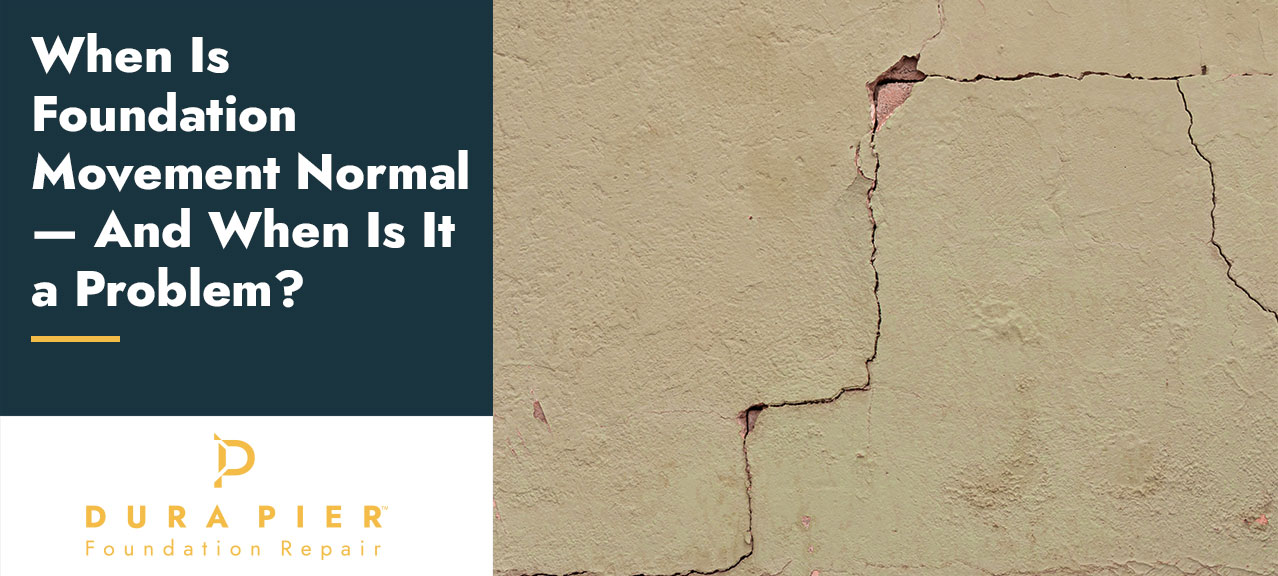
One of the most consistent things we hear from Texas homeowners is some version of: “I noticed a crack / my door is sticking / I have a gap along the ceiling — but my neighbor said that’s just the house settling. Is that true?”
The honest answer is: sometimes yes, sometimes no, and the difference matters a lot.
Texas homes move. That’s not a defect — it’s a reality of building on clay soil in a climate that cycles between heavy rainfall and prolonged drought more aggressively than almost anywhere else in the country. Some degree of movement is expected, accounted for in building design, and genuinely not cause for concern. Other movement is progressive, structural, and gets more expensive to address the longer it continues.
Knowing which is which — and what to actually look for — is what determines whether you’re looking at a maintenance item or a repair conversation. After 45+ years of foundation repair in Houston, Dallas, Fort Worth, Austin, San Antonio, and the surrounding communities, Dura Pier has a clear framework for making that distinction. Here it is.
What “Normal” Foundation Behavior Actually Looks Like in Texas
Texas homes do move seasonally, and that seasonal movement is a direct response to the expansive clay soil beneath them. During the summer dry season, clay shrinks and the edges of the slab — most exposed to evaporation — settle slightly. During wet seasons, that clay re-saturates and expands. This cycle, repeated over years and decades, is simply the environment Texas foundations exist in.
What normal looks like in practice is a home that shows minor, stable signs of this movement that don’t change significantly over time. A hairline crack in drywall at a window corner that has been exactly the same size for three years is a different situation than one that appeared two months ago and has been widening since. A door that sticks slightly during humid summer months and eases back in dry conditions is responding to wood expansion and contraction — a building material behavior, not necessarily a foundation behavior.
The key word in both examples is stable. Normal foundation movement produces symptoms that reach an equilibrium. Problematic foundation movement produces symptoms that are progressive.
The Signs That Are Typically Normal (With Caveats)
None of the following signs are automatically cause for alarm, but all of them deserve monitoring, and any of them can become significant if the underlying conditions change.
Hairline cracks in drywall, particularly at the corners of door and window openings. These are among the most common cosmetic signs in any Texas home and result from the slight racking stress that seasonal foundation movement places on interior wall assemblies. If they appeared during or shortly after initial occupancy and have remained stable, they’re generally considered normal settling. If they’re new, growing, or multiplying, the evaluation changes.
Minor seasonal door sticking — specifically a door that was operating fine in winter or spring and becomes slightly sticky during summer, then loosens again — is often related to humidity-driven wood movement rather than foundation change. This is more common with wooden doors and in high-humidity markets like Houston. The pattern to watch for is whether the sticking is consistent with the season or whether it’s new behavior that’s getting progressively worse.
Small gaps between interior trim and walls or ceilings, particularly in homes more than 20–30 years old. Older homes have had more seasonal cycles to accumulate small cumulative movements, and minor separation at trim lines is common. Stability over time is again the differentiating factor.
Exterior brick with a few isolated mortar cracks in a home that has been standing for decades. Some cracking in masonry mortar over time is normal, particularly at corners and around window openings where thermal and moisture stress concentrates.
The Signs That Are Not Normal and Warrant Professional Evaluation
The following signs indicate movement that is either currently active, historically significant, or structurally consequential enough to warrant a professional assessment — even if the symptoms feel minor.
Cracks that are growing. Any crack — in drywall, brick, concrete, or stucco — that you can document as wider or longer than it was three months ago is active. It doesn’t matter whether it’s currently large or small; the fact that it’s changing is the signal.
Diagonal cracks from door or window corners that are 1/4 inch wide or larger. At this width, the movement that produced the crack was significant enough to require investigation. Width alone doesn’t diagnose severity, but it does indicate that the stress event was material rather than cosmetic.
Horizontal cracks in foundation walls. Unlike the diagonal and corner cracks that result from differential settlement, horizontal cracks indicate lateral soil pressure exceeding the wall’s resistance. In Texas, this is less common than in states with basement-heavy construction, but it is serious when it occurs.
Floors with a perceptible and consistent slope. A floor that slopes noticeably in a specific direction — one that you feel when walking across it or that causes furniture to feel unlevel — indicates that a section of the foundation has settled differentially from the rest. This is not a settling-in symptom; it indicates real structural movement.
Doors or windows that have suddenly stopped operating correctly — and by “suddenly” we mean within recent months, not as a long-standing quirk. A door that has always been slightly sticky in summer is a different situation from a door that closed perfectly six months ago and now won’t latch. New operational problems in multiple locations throughout the home simultaneously are particularly significant.
Gaps between the foundation and the structure above it. Any visible gap where the floor system or wall framing meets the foundation — a gap you can see daylight through, or that you notice has appeared or grown — indicates the structure and foundation are no longer in contact the way they were designed to be.
Plumbing symptoms alongside foundation symptoms. Slow drains, recurring drain backups, or sewer odors appearing at the same time as foundation symptoms is a combination that strongly suggests under-slab drain line movement. The two systems interact in Texas — slab movement stresses embedded pipes, and leaking pipes destabilize the soil that supports the slab. When they show up together, both need to be evaluated together.
The Monitoring Approach: When Watching Makes Sense
Not every situation requires immediate repair, and not every situation warrants watching. The cases where monitoring is genuinely appropriate are ones where:
- The symptoms are mild, stable, and haven’t changed through at least one full seasonal cycle
- The home is relatively new (under 10 years old) and some initial settling is expected
- A professional evaluation hasn’t identified active movement requiring repair
If you decide to monitor, do it with an actual system rather than casual observation. Mark crack endpoints with pencil and date them. Measure widths with a ruler and write it down. Check them at consistent intervals — monthly is reasonable — and particularly after significant rain events and after extended dry periods. This documentation matters: if symptoms do begin to progress, the record of when and how fast they changed is useful information for whoever evaluates the foundation.
Monitoring without documentation is just watching. It gives you the feeling of staying on top of the situation without the information you’d actually need to act on it.
Why Texas Homes Require a Different Standard Than Other Climates
One thing worth noting for Texas homeowners who’ve lived elsewhere or who are reading general foundation guidance from non-Texas sources: the threshold for what constitutes “normal” movement is different here than in climates with less reactive soil.
In regions with sandy soils, rock-based foundations, or soils with low plasticity, very little seasonal movement occurs and any crack or door alignment issue is relatively unusual. Guidance written for those markets will flag symptoms as concerning that a Texas foundation professional might assess as expected given local conditions.
Conversely, because some movement is expected in Texas, there’s a risk in the other direction — homeowners or less experienced contractors dismissing symptoms as “just the clay” when they’re actually progressive. The distinction isn’t primarily about what symptoms are present. It’s about whether those symptoms are stable or changing. That’s the question a thorough evaluation is designed to answer.
When to Stop Monitoring and Call for an Evaluation
The straightforward answer: any time you’re genuinely unsure, a free evaluation from an experienced foundation specialist costs you nothing and gives you actual information. Uncertainty about your foundation’s condition is more expensive than an inspection.
More specifically, call when:
- You’ve been monitoring a crack or alignment issue and it has clearly changed — in any direction — within the past three to six months
- You’re seeing new symptoms you haven’t noticed before, particularly if multiple symptoms are appearing around the same time
- You’re preparing to sell the home, refinance, or take out a home equity loan — a known foundation issue disclosed at that stage is much more manageable than one discovered by an inspector during a buyer’s due diligence process
- You’ve had a significant weather event — an extended drought, a major flood, a severe storm — that you know puts specific stress on Texas foundations, and you want a baseline assessment afterward
Dura Pier evaluates foundations for Texas homeowners across Houston, Dallas, Fort Worth, Austin, San Antonio, and the surrounding communities. Our free inspections include a thorough walkthrough of the interior and exterior, elevation readings where warranted, and an honest assessment of what we find — including the straightforward answer when the answer is “this is normal and nothing needs to be done right now.”
Roughly 24 percent of the homes we evaluate fall into that category. We’ll tell you clearly which one yours is.
Contact Dura Pier today for your free foundation evaluation. Knowing where you actually stand is always better than wondering.