
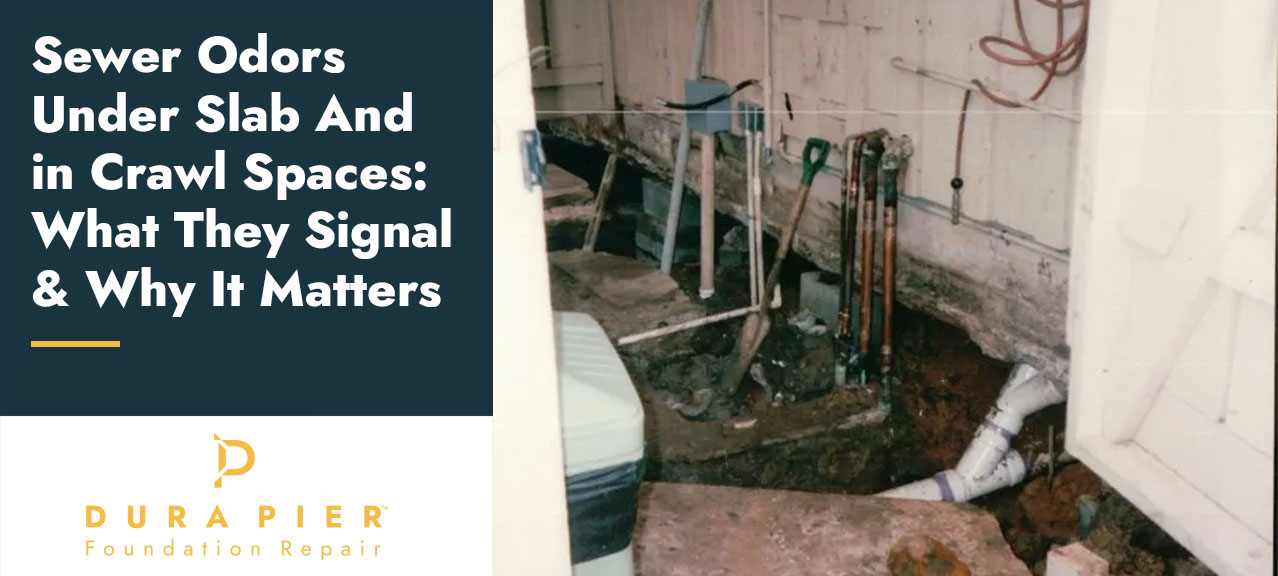
A sewer smell in your home is one of those problems that’s impossible to ignore and easy to misdiagnose. Most homeowners’ first instinct is to call a plumber, and sometimes that’s exactly the right call. But when the odor seems to be coming from below the floor — not from a drain, not from a toilet, not from a vent stack — the situation deserves a closer look, because what’s happening beneath your slab or in your crawl space may be more than a plumbing inconvenience.
At Dura Pier, we’ve been working beneath Texas homes for over 45 years. Sewer line damage under slabs and in crawl spaces is one of the most consequential problems we encounter — not just because of the odor and the health concerns it raises, but because of what that damage does to the foundation itself over time. If you’re smelling sewer gas in your home and the source seems to be below floor level, here’s what you need to understand.
Why Sewer Lines Run Beneath Your Slab
In the majority of Texas homes built on concrete slab foundations, the main drain lines and many of the branch lines serving bathrooms, kitchens, and laundry areas run beneath the slab. This is standard construction — the pipes are embedded in or below the concrete during the original pour, positioned to create the correct slope for drainage before the slab is placed on top of them.
The advantage of this approach is that it keeps the plumbing protected and out of sight. The disadvantage is that when something goes wrong with those lines, access is limited and the consequences extend beyond the pipe itself. Water or sewage leaking from a damaged line beneath a slab doesn’t have anywhere obvious to go — it saturates the soil beneath the foundation, and that saturated soil creates the same kind of uneven pressure and moisture conditions that cause foundation movement.
In pier and beam homes — which are common in older neighborhoods across Houston, Dallas, Austin, and San Antonio — sewer lines often run through or beneath the crawl space. In this configuration, leaks are sometimes easier to detect visually, but the conditions they create in an enclosed crawl space can be equally damaging to the structure above.
What Causes Sewer Lines to Fail Under Texas Homes
Several factors make under-slab and crawl space sewer line failure particularly common in Texas, and most of them connect directly back to the soil conditions that affect the foundation itself.
Clay soil movement is the primary culprit. As Texas expansive clay expands and contracts with seasonal moisture changes, it shifts everything embedded within it — including the drain lines beneath your slab. Pipes that were correctly sloped and properly supported when installed can be pulled out of alignment, separated at joints, or cracked by the repeated loading and unloading the soil imposes on them. Cast iron pipes, which were standard in Texas homes built before the 1980s, are particularly vulnerable to this kind of stress over time.
Root intrusion is a secondary but significant cause. The same tree roots that can destabilize foundation soil are attracted to sewer lines — which provide a reliable source of water and nutrients. Roots infiltrate through joints and small cracks, then grow and expand inside the pipe until they create blockages or structural failure. In older neighborhoods with mature trees, this is one of the most common causes of crawl space sewer odors.
Age and material degradation affect older homes throughout the state. Cast iron corrodes from the inside out over decades, and orangeburg pipe — a fiber-and-tar material used in some mid-century construction — deteriorates even more rapidly. If your home was built before 1980 and has never had its sewer lines evaluated, there’s a meaningful probability that some degradation has occurred.
Foundation movement itself can damage lines even when the pipes are otherwise in good condition. When a slab shifts — whether from clay soil movement, pier settlement, or moisture changes — the pipes embedded beneath it shift with it, or don’t, depending on where they’re located relative to the movement. That differential creates stress concentrations at joints and connections that can cause failures over time.
What the Odor Is Actually Telling You
Sewer gas is a mixture that includes hydrogen sulfide, methane, ammonia, and other compounds produced by the decomposition of organic waste in the drain system. Under normal conditions, the water trapped in p-traps beneath every fixture in your home acts as a seal that prevents sewer gas from entering the living space.
When sewer gas is coming from below the floor — rather than from a drain that’s been unused long enough for the p-trap to dry out — it typically indicates one of three things.
An active leak in a drain line beneath the slab or in the crawl space. This is the most common source of persistent below-floor sewer odors. A crack or separation in a drain line allows sewage and gas to escape into the soil or crawl space. Depending on the location of the break and the soil conditions, the gas migrates upward through gaps in the slab, through expansion joints, through the space around pipe penetrations, or directly through the crawl space floor system into the living areas above.
A break or crack in a vent line that runs through the slab or wall cavity. Vent lines are designed to allow sewer gas to exit through the roof. When a vent line is damaged below floor level, the gas exits at the damage point rather than through the roof, and can accumulate beneath the slab or in wall cavities before reaching the interior.
Significant sewage accumulation in a crawl space. In pier and beam homes with a drain line failure in the crawl space, sewage can pool in low spots in the crawl space before anyone above it realizes there’s a problem. The odor often presents first, sometimes for months, before a homeowner investigates the crawl space and finds the actual source.
The Foundation Connection: Why a Plumbing Problem Becomes a Structural One
This is the dimension of under-slab sewer damage that most homeowners don’t think about until they’re dealing with it — and it’s the reason Dura Pier is part of this conversation rather than just a plumber.
When a sewer line beneath a slab is actively leaking, the water and sewage it releases saturates the soil in a concentrated area beneath the foundation. That saturated soil behaves very differently from the surrounding dry or moderately moist soil — it’s softer, it expands if it’s clay, and it provides less consistent support to the slab above it. The slab, now lacking uniform support in that area, begins to move differentially.
In many cases, a homeowner notices foundation symptoms first — a door that suddenly won’t close, a crack that appeared seemingly overnight, a floor that feels noticeably uneven in one room — and calls a foundation company without realizing there’s a plumbing failure driving the problem. We’ve arrived at countless inspections over the years where the foundation movement turned out to be secondary to an under-slab sewer leak that had been saturating the soil beneath that section of the house for months or years.
Repairing the foundation without identifying and repairing the sewer line is an incomplete solution. The leak continues, the soil continues to be destabilized, and the repaired foundation has a much harder time staying in place.
In pier and beam homes, the problem presents differently but the stakes are similar. Sewage pooling in a crawl space creates chronic moisture and biological conditions that accelerate wood rot in the floor framing, subfloor, and support beams. What begins as a drain line problem becomes a structural wood deterioration problem that can compromise the integrity of the floor system above.
Signs That Point Specifically to Under-Slab or Crawl Space Sewer Issues
How do you distinguish a sewer odor that’s coming from below the floor versus one with a simpler above-floor source? Here are the specific indicators that should prompt a below-floor investigation.
- The odor is strongest at floor level or seems to come up through the floor itself rather than from a specific drain or fixture
- The odor is present in areas of the home that don’t have plumbing fixtures directly above them — a hallway, a living room, a bedroom
- You notice the smell is worse in damp conditions or after heavy rain, which can pressurize gas through soil and slab openings
- Water or sewage has been detected in the crawl space during previous inspections or by a pest control company
- Your home is more than 30 years old and has never had a sewer line inspection
- You’re already experiencing foundation movement symptoms — sticking doors, drywall cracks, sloping floors — alongside the odor
Any of these conditions in combination with a persistent sewer smell below floor level warrants a professional evaluation that addresses both the plumbing and the foundation systems together.
How Dura Pier Approaches Under-Slab Sewer and Foundation Issues
Dura Pier’s sewer line repair capabilities are specifically designed for the under-slab and crawl space environment. We use high-resolution video camera inspection to assess the interior condition of drain lines without excavation, identifying cracks, root intrusion, joint separations, and pipe deterioration precisely. This diagnostic step is critical — it tells us exactly where the failure is and what kind of repair is required before any work begins.
When repair is needed, our approach depends on the specific failure and its location. Targeted tunneling beneath the slab allows us to access and repair or replace damaged sections of line without removing the slab above — preserving the foundation while restoring the drainage system. In crawl space environments, drain line repair is often combined with moisture remediation and structural assessment of any framing that has been affected by prolonged exposure.
Following sewer line repair, we assess the foundation condition — evaluating whether the soil disturbance caused by the leak has contributed to settlement or movement that requires stabilization. In many cases, pier installation beneath the affected area is recommended to restore support in zones where the soil was compromised by long-term moisture infiltration.
Addressing both systems in a coordinated repair is the only way to ensure that the structural problem doesn’t continue after the plumbing problem is fixed.
Don’t Ignore the Smell
Sewer odors are not something to mask with air fresheners and revisit later. Beyond the foundation implications, sewer gas itself carries genuine health concerns with prolonged exposure — hydrogen sulfide and methane are both hazardous at elevated concentrations, and a drain line failure beneath an enclosed crawl space can create conditions where those concentrations build over time.
If you’re experiencing persistent sewer odors that seem to originate below floor level, Dura Pier offers free foundation and sewer line evaluations for homeowners across Texas — in Houston, Dallas-Fort Worth, Austin, San Antonio, and the surrounding communities. We’ll identify what’s happening beneath your home, explain what we find, and recommend the right sequence of repairs to address both the plumbing and the foundation.
Contact Dura Pier today to schedule your free evaluation. What’s under your slab matters more than most homeowners realize.