
Foundation repair estimates can feel like a black box. You call a few companies, they come out, they look at your house, and they hand you numbers that might range from $4,000 to $40,000 — for what sounds like similar work. The variation is confusing, and for a homeowner who’s never dealt with a foundation issue before, it’s hard to know how to evaluate what you’re being told, what’s driving the difference, and whether the number in front of you is fair.
This is a question we hear often, and we’d rather answer it directly than let homeowners navigate it without context.
After 45+ years of repairing foundations across Texas — in Houston, Dallas, Fort Worth, Austin, San Antonio, and every market in between — Dura Pier has a clear view of what actually drives foundation repair pricing. Some of it is straightforward. Some of it surprises people. All of it is worth understanding before you sign anything.
The Biggest Driver: How Many Piers Your Home Needs
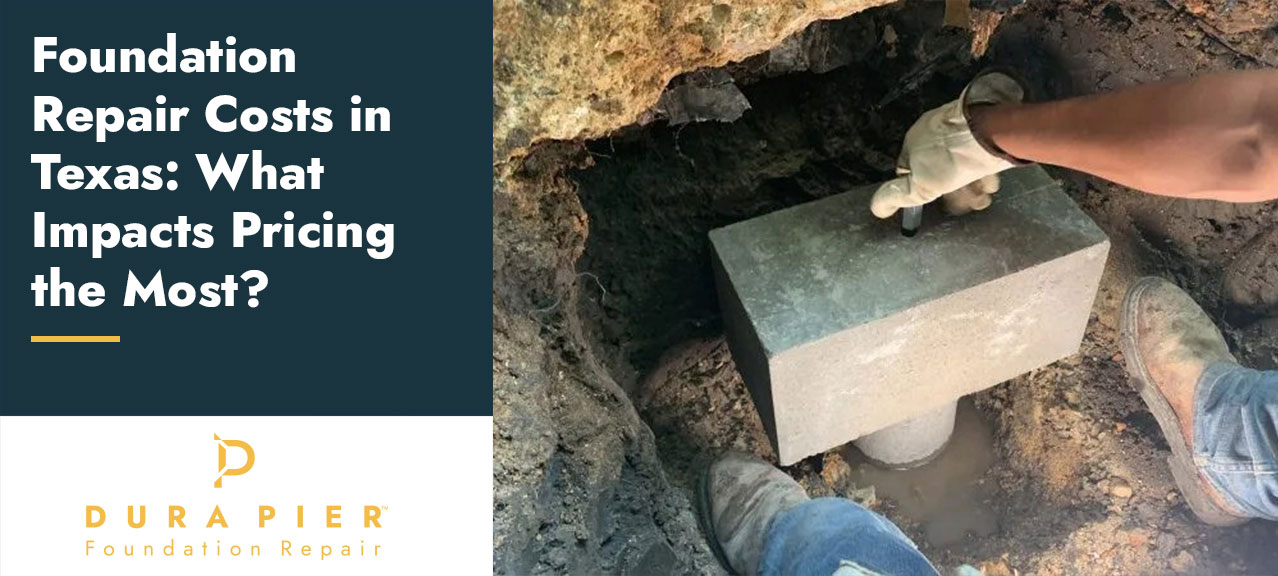
For the majority of Texas foundation repairs involving significant settlement or movement, the primary cost variable is the number of piers required and the method used to install them. Piers are the structural anchors that transfer your foundation’s load past the unstable near-surface clay to the stable bearing soil below — and every pier represents materials, equipment time, and labor.
The number of piers a home needs is determined by the pattern and extent of movement across the foundation, not just the square footage of the home. A 2,000 square foot home with movement concentrated along one wall might need 8–10 piers. A similar home with movement distributed around the entire perimeter could need 20 or more. The inspection process — specifically, elevation readings taken at systematic points across the slab — is what determines this number accurately. Any estimate given before that measurement process is complete is a rough approximation at best.
The type of pier also affects pricing. Dura Pier’s proprietary Dura Lock XD® piling system uses bolted steel construction where segments are connected and tensioned as they’re driven, creating a locked, continuous column rather than a stack of individual pressed sections. This is a more material-intensive system than basic pressed concrete pilings, but it produces a more durable result — one that’s backed by a lifetime warranty because it’s designed to perform across the full range of Texas soil conditions.
Foundation Type: Slab vs. Pier and Beam
The type of foundation your home is built on has a significant effect on both the method and the cost of repair.
Slab foundations — the most common type across Texas — require pier installation from below the slab. In most cases, this involves drilling or excavating small access points and driving piers adjacent to the footing. The process is minimally invasive to the interior, though some interior work may be required depending on the repair design.
Pier and beam foundations — more common in older neighborhoods and in certain regions of Texas — involve a different set of repair approaches. When the structure’s wood components (beams, posts, sills) are sound but the support columns have shifted or settled, re-leveling and installing new supports is often a less intensive repair than pier installation under a slab. However, when the wood framing itself has deteriorated — due to moisture, rot, or pest damage — the cost increases significantly because the structural members themselves need to be rehabilitated, not just the support system beneath them.
Accessibility and Site Conditions
Two homes with identical foundation problems can have meaningfully different repair costs depending on how accessible the work areas are.
Interior access limitations affect the equipment and methods that can be used for pier installation. A home with a finished basement or a tight mechanical room adjacent to the footing line may require more careful work than a home with an open, accessible perimeter. Concrete cutting for pier access in tight spaces takes longer and costs more.
Exterior access limitations are equally important for approaches that require working outside the foundation. Homes with narrow side yards, close fence lines, mature landscaping near the perimeter, or hardscape — driveways, patios, pool decks — adjacent to the repair area may involve additional restoration work or require modified installation sequences.
Lot slope and drainage conditions also play a role. Homes on sloped lots sometimes have taller exposed foundation walls, which changes the geometry and complexity of the repair. Sites with poor drainage that have contributed to soil movement may need drainage correction as part of the repair plan — an additional scope item that adds to the total but is often necessary to protect the repair long term.
The Severity and Age of the Movement
How far the foundation has moved, and how long it has been moving, both affect repair complexity.
Recent movement — a slab that has shifted over one or two seasons — often involves soil that hasn’t compacted around the damage yet, making it somewhat more straightforward to address.
Long-term movement — a foundation that has been slowly settling for a decade or more — may involve secondary damage throughout the home (cracked interior walls, distorted door frames, separated trim) that complicates the repair. It may also involve soil voids that have developed beneath the slab as the foundation settled, which need to be addressed alongside the pier installation to prevent the slab from having unsupported sections after it’s lifted.
Severely settled foundations sometimes require a more carefully staged repair to avoid damaging above-grade finishes during the lifting process. A home that has settled 3–4 inches can’t simply be pushed back to level in one aggressive lift — it requires a controlled, incremental approach that takes more time and precision.
Whether Drainage Correction Is Part of the Scope
This is the cost variable that surprises homeowners most often, because it’s not “foundation repair” in the traditional sense — and yet it’s frequently a necessary part of a complete repair.
If the movement Dura Pier identifies during your inspection is being driven by chronic moisture imbalance around the foundation — poor drainage causing one side of the home to experience dramatically different moisture levels than the other — addressing that drainage is part of fixing the problem, not just addressing the symptom. A foundation stabilized with piers but left in a drainage environment that continues to saturate the soil unevenly will be fighting a disadvantage that limits the long-term performance of the repair.
Drainage correction scope can range from relatively simple — adding a downspout extension or regrading a small yard section — to more significant, involving French drains, yard regrading across a larger area, or a full Dura Pier drainage system installation. The extent of drainage work required has a real effect on the total project cost, but it’s work that protects the structural investment you’re making.
Typical Cost Ranges in the Texas Market
We believe in transparent pricing, so here’s an honest look at the ranges you should expect to encounter for foundation repair in Texas.
Targeted pier installation for localized settlement (smaller homes or limited movement areas, 8–12 piers): typically in the $8,000–$18,000 range.
Moderate repair scope (average-sized homes with perimeter movement, 12–20 piers): typically in the $15,000–$30,000 range.
Larger or more complex repairs (larger homes, distributed movement, difficult access, or secondary soil issues): $25,000 and above, with some complex projects going higher.
Pier and beam rehabilitation varies considerably based on what the inspection finds — targeted support work can be less expensive than slab pier installation, but significant wood frame deterioration can make pier and beam rehab a larger project.
These are ranges, not quotes. The only honest quote for your specific home comes after a thorough on-site evaluation with elevation measurements — not from a phone call or an internet estimate calculator.
What to Watch Out For in Foundation Repair Estimates
Having worked in the Texas foundation market for over four decades, we’ve seen the full spectrum of how this industry presents pricing to homeowners. A few things worth knowing as you evaluate estimates.
An unusually low pier count on a home with obvious widespread movement may indicate that the estimating process was not thorough, or that the proposal is designed to get in the door at a lower price with the expectation of change orders. The pier count should come from measured elevation data, not visual observation alone.
Per-pier pricing with no explanation of the pier system makes it difficult to evaluate what you’re actually buying. A pressed concrete piling and a Dura Lock XD® bolted steel piling are not the same product, and the warranty that stands behind them reflects that difference.
An estimate with no discussion of drainage on a home that clearly has moisture-related movement patterns may be missing a significant component of what the property actually needs.
A warranty with fine print — transfer fees, exclusions, or requirements that void coverage — is a materially different product than a simple lifetime transferable warranty with no exceptions. Compare what’s actually being offered, not just the word “warranty.”
Financing Options — Because This Is Rarely a Planned Expense
Foundation repair is almost never something homeowners budget for in advance, and the cost range can feel daunting. Dura Pier offers financing options through trusted lending partners, including rates as low as 0% for 12 months, because we’d rather help homeowners address the problem now than watch it become a larger and more expensive one over the next several dry seasons.
The economics of waiting are consistently unfavorable. A repair that costs $15,000 today doesn’t become $10,000 by waiting — it becomes $22,000 when the additional movement it causes over the next two years requires more piers and more involved slab work.
Start with a Free, Honest Evaluation
The only way to know what your foundation actually needs — and what it will actually cost — is a thorough on-site inspection that includes elevation measurements and an honest assessment of the soil and drainage conditions contributing to the movement.
Dura Pier provides free foundation evaluations for homeowners across Texas. We’ll explain exactly what we find, what we recommend, and what it will cost — clearly and without pressure. And in roughly 24 percent of evaluations, the honest answer is that no repair is needed at all right now.
Contact Dura Pier today to schedule your free foundation evaluation. Understanding what you’re dealing with is always the right first step.