
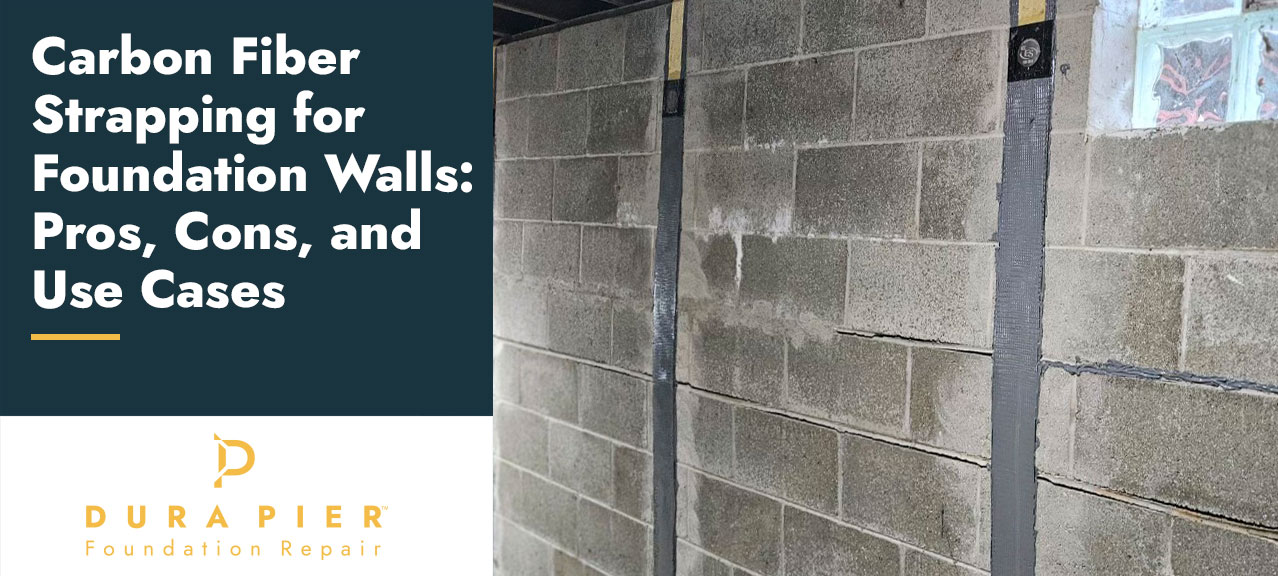
When foundation walls begin to fail, understanding the pros and cons of carbon fiber versus steel reinforcement becomes essential for homeowners. Both materials offer effective solutions for stabilizing cracked, bowing, or leaning foundation walls, however they differ significantly in application, cost, and long-term performance.
Carbon fiber reinforcement has gained popularity for its non-invasive installation and high tensile strength, while steel I-beams have long been trusted for addressing severe structural shifts. Whether you’re dealing with minor cracks or significant wall displacement, choosing the appropriate reinforcement method directly impacts your home’s structural integrity and your budget.
In fact, the decision between these two foundation repair methods depends on multiple factors including the severity of wall movement, space considerations, and long-term durability needs. For instance, carbon fiber might be ideal for walls with minimal bowing, whereas steel may be necessary for walls with extensive structural damage.
This article examines the critical differences between carbon fiber and steel foundation wall repairs, helping you make an informed decision about the best solution for your specific foundation issues.
Understanding Foundation Wall Stress and Movement
Foundation walls silently endure enormous pressures every day, supporting not just your home but also resisting the forces exerted by surrounding soil. Understanding these forces and recognizing early signs of failure are essential steps before considering any reinforcement options.
Soil Pressure and Hydrostatic Forces
Foundation walls constantly battle against external pressure from surrounding soil. This pressure varies dramatically based on soil composition and moisture levels. Clay-based soils act essentially like sponges—expanding when wet and contracting when dry—creating cycles of pressure that test foundation strength over time. During wet seasons or after heavy rainfall, these soils absorb water, swell dramatically, and push against foundation walls with significant force.
Hydrostatic pressure represents an even greater threat to foundation integrity. This pressure occurs when water saturates the soil surrounding a foundation, creating a powerful sideways force. One cubic foot of water alone weighs over 62 pounds, and as this water accumulates in soil around your foundation, it multiplies the lateral pressure. During periods of heavy rainfall or snowmelt, this pressure intensifies as the soil becomes oversaturated.
Poor drainage further compounds these problems. When water cannot drain away properly, it pools around foundation walls, steadily increasing pressure until cracks form. This is particularly problematic in regions with clay-heavy soils or areas that experience dramatic shifts between drought and heavy rainfall.
Common Signs of Wall Failure: Cracks, Bowing, and Leaning
Foundation wall failure typically progresses through distinct stages, beginning with subtle warnings before advancing to serious structural compromise:
- Horizontal Cracking – The first visible sign often appears as horizontal cracks across the middle section of foundation walls, indicating pressure is exceeding the wall’s resistance. These cracks typically form at the wall’s weakest point and serve as an early warning system.
- Stair-Step Cracking – As pressure continues, diagonal or stair-step cracks emerge from corners, following mortar lines in brick or block foundations. These cracks signal the wall is beginning to shift under pressure.
- Bowing or Bulging – With ongoing pressure, walls begin to curve inward, usually at their center point—a condition known as bowing. This represents a significant breakdown of the wall’s structural integrity.
- Wall Leaning or Top Rotation – In advanced stages, the top of the wall starts leaning inward while remaining anchored at the bottom, a condition structural engineers identify as rotation. At this point, the wall is experiencing serious structural failure.
Additionally, you might notice water seepage through cracks, sticking doors or windows, and uneven floors as secondary indicators of foundation wall movement.
Why Reinforcement Is Critical for Structural Integrity
A compromised foundation wall threatens your entire home’s structural stability. The foundation serves as the essential base that transfers the weight of your building to the underlying soil. Once this system begins to fail, the consequences extend throughout the structure.
Reinforcement becomes crucial because concrete alone performs well under compression but poorly under tension or bending forces. Furthermore, as foundation walls bow or lean, they begin to separate from adjacent walls, compromising the entire foundation system.
Proper reinforcement distributes stress evenly throughout the foundation structure, preventing further movement and potential catastrophic failure. Without intervention, what begins as a simple crack can progress to complete wall collapse, which may lead to extensive structural damage including split flooring, snapped beams and joists, cracked drywall, and broken water pipes.
Ultimately, reinforcing a failing foundation wall is not just about fixing a problem—it’s about preventing a cascade of increasingly serious and expensive structural issues that could eventually threaten your home’s habitability.
How Carbon Fiber and Steel Reinforcements Work
Both carbon fiber and steel reinforcements work by counteracting the lateral forces pushing against foundation walls, yet they function through fundamentally different mechanisms. The choice between these solutions often determines not only repair effectiveness but also long-term structural integrity.
Carbon Fiber Straps: Epoxy Bonding and Load Distribution
Carbon fiber reinforcement relies on high-strength fibers bonded directly to foundation walls. This system features unidirectional carbon fibers with remarkable tensile strength—over 720 ksi in dry fiber and 200 ksi in certified laminate strength. Unlike materials that stretch under pressure, carbon fiber’s resistance to stretching creates a powerful restraint system.
The installation process begins with thorough wall preparation, removing any paint or debris to ensure proper adhesion. Subsequently, industrial-strength epoxy is applied to the wall surface. This specialized epoxy penetrates deeply into concrete pores, creating thousands of connection points rather than merely surface bonding. Once the carbon fiber strap is positioned, a second coat of epoxy completes the seal.
What makes this system truly effective is its anchoring methodology. The straps are secured at both the top and bottom of the wall with specially designed brackets. The top anchor attaches to the rim joist (the lowest layer of the main floor framing), preventing inward sliding of the wall top. Simultaneously, the bottom anchor connects to the basement floor, stopping any potential shearing or sliding movement at the wall base.
This complete system effectively distributes lateral soil pressure across the entire reinforcement, preventing further wall movement once the epoxy cures. At only 0.02 inch thick, the finished installation creates minimal intrusion into living space.
Steel I-Beams: Bracing and Load Transfer Mechanism
Steel reinforcement takes a different approach, utilizing vertical I-beams positioned against the failing wall. These beams—typically 4 inches deep and weighing 9.5 pounds per foot—are placed at intervals determined by wall type: 4-5 feet apart for concrete walls and 3-4 feet for block or stone walls.
The installation begins with breaking through the concrete floor at each beam location. The I-beam is then positioned against the wall, held plumb, and secured at both top and bottom. At the top, the beam connects to floor joists using either a 2×10 block or 3×3 angle iron. For joists running parallel to the wall, solid blocking must extend several joists back, transferring the load throughout the floor system rather than concentrating it on a single joist.
At the base, each I-beam is set in a concrete pier extending 12-16 inches below the footing. Finally, stiff concrete is packed into the gap between beam and wall, creating a unified structural system. Some advanced systems include jackscrews in the top brackets, allowing gradual wall straightening over time.
This configuration transfers the wall’s lateral load to both the house structure above and the earth below, effectively bypassing the weakened foundation wall itself.
Installation Differences: Interior vs Exterior Access
The installation approaches for these systems differ considerably in terms of disruption and accessibility. Carbon fiber installation is entirely interior-based and minimally invasive. No exterior excavation is necessary, making it ideal for properties with landscaping concerns or limited exterior access. The process typically completes in a single day with minimal dust or household disruption.
Conversely, steel beam installation requires breaking concrete flooring and sometimes exterior excavation if the wall needs to be pushed back into position before stabilization. This process creates more disruption and typically takes longer to complete. Nevertheless, modern channel steel has replaced traditional bulky I-beams in many applications, reducing the finished profile considerably.
Both systems work entirely from inside the basement, though their impact on finished space differs significantly. Carbon fiber straps can be painted over and easily concealed behind standard wall finishes. Steel beams, even with lower-profile channel steel, still protrude several inches into the room, though they can be incorporated into stud walls during basement finishing.
The choice between these methods often depends on wall displacement severity, with carbon fiber typically recommended for walls bowed less than 2 inches and steel preferred for more severe cases.
Pros and Cons of Carbon Fiber for Foundation Repair
Carbon fiber technology offers a modern approach to foundation wall stabilization, providing specific advantages alongside certain limitations that homeowners should consider before choosing this repair method.
Non-Invasive Installation with Minimal Disruption
Carbon fiber installation stands out primarily for its simplicity and minimal household disruption. The process requires no exterior excavation and can typically be completed in just a few hours. Since all work occurs from inside the basement, homeowners avoid the landscaping damage often associated with traditional repair methods. The installation procedure follows a straightforward sequence: walls are prepared by grinding them flat, industrial-grade epoxy is applied, and carbon fiber strips are pressed into position. Once secured to both the sill plate and foundation floor, the repair creates a permanent stabilization system. This clean, efficient process causes minimal interference with daily household activities, making it considerably less intrusive than alternatives requiring heavy equipment.
High Tensile Strength and Corrosion Resistance
Despite its lightweight appearance, carbon fiber delivers remarkable structural reinforcement. These materials feature tensile strength of up to 800 ksi, approximately ten times stronger than steel. Moreover, the carbon fiber matrix is inherently non-corrosive and immune to moisture damage. Unlike steel reinforcements that deteriorate over time, carbon fiber systems remain stable and effective even in damp basement environments. This corrosion resistance ensures long-term performance without requiring periodic maintenance checks or adjustments. Once professionally installed, carbon fiber systems can provide structural support for up to 50 years, offering homeowners a truly permanent solution.
Limitations on Severely Bowed or Block Walls
Despite its impressive capabilities, carbon fiber reinforcement is not suitable for all foundation problems. It functions optimally on poured concrete walls with inward movement of two inches or less. Walls bowing beyond this threshold typically require more robust intervention methods. Additionally, carbon fiber provides reinforcement that prevents further movement without correcting existing displacement—it stabilizes walls in their current position instead of straightening them. Certain wall types present further limitations; although carbon fiber works on both concrete block walls and poured concrete, it is generally less effective on severely damaged CMU blocks. Consequently, foundation professionals must conduct thorough evaluations to determine if carbon fiber represents the appropriate solution for specific foundation issues.
Pros and Cons of Steel I-Beams for Foundation Repair
Steel I-beams represent the traditional heavyweight solution in foundation wall repair, offering distinct advantages for structurally compromised walls that lighter solutions cannot address.
Effective for Severe Bowing and Structural Shifts
Steel I-beam systems excel specifically where carbon fiber falls short—handling walls with significant displacement. These robust reinforcements effectively stabilize walls that have bowed more than 2 inches or suffered severe structural damage. Placed vertically against failing walls and secured both above and below, steel beams create a rigid barrier that transfers soil pressure away from the compromised wall and into the beam itself. Notably, steel I-beams provide immediate stabilization without requiring external excavation, making them suitable for homes with limited outdoor access.
Additionally, some advanced systems like PowerBrace feature adjustment mechanisms that allow gradual wall correction over time. During dry seasons when soil shrinks, these systems can be tightened, potentially reversing wall failure without invasive drilling or digging.
Invasive Installation and Space Intrusion
Nonetheless, steel beam installation requires considerably more disruption than alternatives. The process typically involves breaking through concrete floors to create holes where beams will be anchored 12-16 inches below the footing. Each beam must be secured at both the base during installation and to the floor joists above.
Perhaps the most significant drawback involves space consumption. Steel beams protrude 6-12 inches into the basement area, permanently reducing usable floor space. This intrusion can complicate finishing plans and affect the basement’s functionality.
Long-Term Durability vs Maintenance Requirements
Regarding longevity, steel offers impressive durability. Properly installed steel supports last virtually indefinitely—typically 100 years or more. Manufacturers commonly offer warranties of 35+ years.
Henceforth, maintenance requirements vary by system type. Basic I-beam installations require minimal maintenance once properly installed. Conversely, adjustable systems benefit from annual inspections where technicians use laser levels to record improvement benchmarks and adjust tightness.
Regardless of their spatial impact, steel I-beams remain unmatched for severely compromised walls where structural integrity has been significantly threatened.
Cost, Longevity, and Use Case Comparison
Comparing the financial aspects and practical applications of both reinforcement methods helps homeowners make informed decisions based on their specific foundation issues.
Initial Installation Costs: Carbon Fiber vs Steel
The financial investment varies substantially between these foundation solutions. Carbon fiber straps typically cost $350 to $1000 per strap. For a standard 20-24 foot bowing wall requiring approximately 5 straps, the total expense ranges from $1750 to $5000. Comparatively, steel reinforcement systems involve additional labor for floor breaking and concrete work, yet overall costs remain competitive. Both methods generally range from $4000 to $12000 for a complete wall reinforcement system.
Expected Lifespan and Maintenance Needs
Durability represents a critical difference between these solutions. Carbon fiber systems typically last up to 50 years with virtually no maintenance requirements due to their corrosion resistance. Steel systems, albeit requiring occasional inspection, can remain effective for 75-100+ years when properly installed. Steel with adjustment mechanisms may need annual tightening to maximize corrective potential.
Best Use Cases Based on Wall Displacement Severity
Wall displacement severity primarily dictates which solution proves most appropriate. Carbon fiber excels with walls bowed less than 2-3 inches, offering sufficient stabilization without excessive intervention. Alternatively, steel becomes necessary when walls exceed this threshold, especially for walls bowed beyond code limits requiring actual wall repositioning capabilities. Precisely this difference in capability explains why professionals thoroughly assess wall condition before recommending either solution.
Conclusion
Choosing between carbon fiber and steel reinforcement ultimately depends on your specific foundation wall issues. Both methods effectively stabilize compromised foundation walls, albeit through different mechanisms suited to varying damage levels. Carbon fiber excels as a non-invasive solution for walls with minimal bowing—specifically less than 2 inches of displacement. Additionally, its quick installation, minimal space intrusion, and impressive tensile strength make it ideal for homeowners prioritizing convenience alongside structural support.
Steel I-beams, conversely, provide the robust reinforcement necessary for severely compromised walls. Their ability to handle substantial displacement exceeding 2 inches makes them irreplaceable for critical structural concerns. Furthermore, certain systems offer gradual wall correction capabilities impossible with carbon fiber alternatives. However, this comes at the cost of significant space intrusion and more disruptive installation.
Cost considerations remain relatively comparable between both methods, though maintenance needs differ substantially. Carbon fiber typically requires almost no maintenance throughout its 50-year lifespan, whereas steel systems—particularly adjustable varieties—benefit from periodic inspection and adjustment to maximize their corrective potential.
The decision between these reinforcement methods should never be made without professional assessment. Foundation repair experts evaluate wall displacement severity, structural material, soil conditions, and space requirements before recommending the appropriate solution. This assessment ensures you select the most effective repair method for your home’s specific foundation issues.
Therefore, whether you opt for the modern, space-saving approach of carbon fiber or the traditional strength of steel I-beams, addressing foundation wall failure promptly protects your home’s structural integrity and prevents escalating damage. The right reinforcement solution stabilizes your foundation walls while providing decades of reliable performance, safeguarding your home’s value and your family’s safety for years to come.